What if the $140,000 you invested in your home was actually a legal liability waiting for a city inspector? Most homeowners we speak to in the Ottawa area are eager to tap into the city’s $2,395 median monthly rent for two-bedroom units, yet they’re understandably anxious about the 2026 building code updates. It’s common to feel overwhelmed by the technicalities of fire separation or the fear of being forced to decommission a suite because of a missed permit. Creating a legal basement apartment ottawa requires more than just a good layout; it demands a precise understanding of provincial Bill 23 exemptions and local safety standards.
You deserve to know that your investment is safe and your tenants are protected. This guide provides a clear roadmap to a legal occupancy permit, covering everything from the 6 foot 5 inch ceiling height requirement to the specific egress window dimensions needed for compliance. We’ll explore the real-world costs of construction and the common pitfalls where projects often go wrong. By the end of this article, you’ll have the confidence to move forward with a renovation that’s both profitable and fully compliant.
Key Takeaways
- Understand the financial and legal risks of unpermitted suites, including potential insurance denials and city-ordered decommissioning.
- Identify the mandatory safety requirements for a legal basement apartment ottawa, ranging from 30-minute fire-rated assemblies to specific egress window dimensions.
- Learn how the 2026 building code updates impact your HVAC and fire separation strategy to ensure your renovation is safe for long-term tenants.
- Discover why a structured pre-construction planning phase is essential to eliminate the “guestimate” pricing that often leads to budget overruns.
- Master the roadmap to securing a legal occupancy permit through a transparent process that prioritizes clear communication and structured management.
Navigating Ottawa’s Secondary Dwelling Unit Bylaws in 2026
Many homeowners in the Ottawa and Prescott-Russell area view a basement conversion as a sophisticated financial asset. It’s a strategic way to build equity while providing much-needed housing. However, the legal framework in 2026 is precise. In Ottawa, a basement apartment is only legal if it possesses a registered occupancy permit following a passed final inspection. Skipping this step is a high-stakes gamble that often leads to insurance denials, safety liabilities, or city-ordered decommissioning. We believe in an “educate first” philosophy because understanding your property’s legal potential is the only way to protect your investment before you spend a single dollar.
Zoning and Feasibility: Using GeoOttawa
Your project’s feasibility depends entirely on your property’s zoning. Most homeowners we speak to are surprised to learn that their “as-of-right” status isn’t always guaranteed. You can use the GeoOttawa online mapping tool to verify your specific zoning code and any overlays that might affect your build. While the city generally encourages a Secondary Dwelling Unit in most residential areas, certain restrictions on lot size or parking can trigger the need for a minor variance. This legal hurdle can add months to your timeline, so verifying these details is the first step in our structured planning process.
The 2026 Permit Landscape
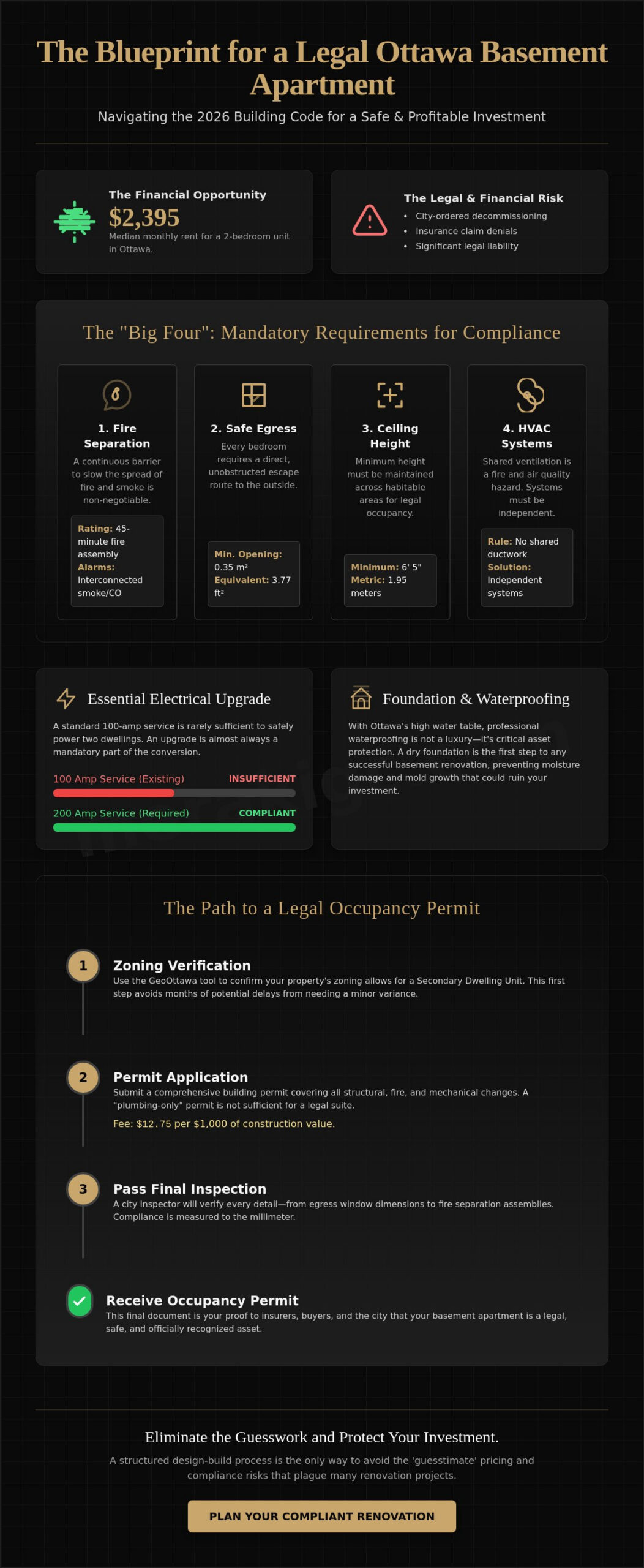
The Building Code Services (BCS) application process is the gatekeeper for your legal basement apartment ottawa. Here’s where projects go wrong: many people believe the myth that a “plumbing-only” permit is enough for a suite. In reality, a true legal conversion requires a comprehensive building permit that covers structural changes, fire safety, and mechanical systems. The city’s current fee of $12.75 per $1,000 of construction value is a small price to pay for the security of a legal occupancy permit. This document is your proof to future buyers and insurers that the space is safe, compliant, and officially recognized by the city.
The Technical Blueprint: Mandatory Requirements for a Legal Suite
Building a legal basement apartment ottawa involves meeting strict technical standards that go beyond basic aesthetics. The City of Ottawa classifies these as the “Big Four” of compliance: fire separation, egress, ceiling height, and HVAC systems. These requirements significantly influence the scope of basement renovations in Ottawa, as they dictate the structural and mechanical layout of the entire home. We often see projects fail at the inspection stage because these core elements were treated as afterthoughts rather than the foundation of the design.
Ottawa’s local conditions add another layer of complexity. Many neighborhoods sit on a high water table, making professional waterproofing a critical component of basement finishing. Without a robust strategy for moisture control, your investment in high-end finishes is at constant risk. Ensuring your foundation is dry and secure is just as important as meeting the official City of Ottawa permit guide requirements for habitable space.
Egress and Fire Safety: Non-Negotiables
Fire safety is the most scrutinized aspect of a secondary suite. The 2026 building code requires a 45-minute fire-rated assembly between the main dwelling and the basement unit. This usually involves specific types of drywall and resilient channels to slow the spread of fire and smoke. You must also install interconnected smoke alarms throughout the entire house. If an alarm triggers in the basement, it must sound upstairs too. Every bedroom requires an egress window with a minimum opening of 0.35 square meters (3.77 square feet). This ensures a safe exit route in an emergency; city inspectors will measure this to the millimeter.
HVAC and Electrical Standards
Air quality and power capacity are common sticking points. Shared ductwork between units is generally not permitted unless you install expensive fire dampers, so many homeowners opt for independent heating systems. This ensures that smoke or odors don’t travel between the two units. On the electrical side, a standard 100-amp service is rarely enough to support a second kitchen with a stove and laundry. Upgrading to a 200-amp panel is often a mandatory step for a legal basement apartment ottawa to handle the increased load safely. If you’re looking for a partner to manage these complexities, our design-build project management provides the structured oversight needed for a successful build.
The Design-Build Path: Costs, Risks, and Avoiding Project Failure
The transition from a technical blueprint to a physical reality is where most homeowners feel the highest level of anxiety. Here’s where projects go wrong: many contractors provide “guestimate” pricing during a walkthrough without conducting a deep dive into the home’s existing infrastructure. This lack of pre-construction planning often leads to budget overruns when hidden issues, like outdated wiring or foundation cracks, appear behind old drywall. We believe the design-build process is the only reliable way to guarantee a fixed price for your secondary suite. The “Measured, Managed, MasterCrafted” approach used by Meraki General Contracting replaces guesswork with detailed scoping, ensuring your legal basement apartment ottawa stays on budget.
By investing in professional planning before hammers swing, you eliminate the risk of “surprise” change orders. You gain a partner who manages the city inspections and technical compliance, allowing you to focus on the long-term ROI of your property rather than the stress of the job site.
What Does a Legal Basement Apartment Cost in Ottawa?
In 2026, a high-quality legal basement apartment ottawa typically requires an investment between $120 and $300 per square foot. For a standard 1,000-square-foot basement, a realistic budget is approximately $140,000. While a simple “rec room” might cost less, a legal suite demands significant spending on structural fire separation, independent HVAC systems, and separate utility meters. Most homeowners we speak to find that while the initial cost is higher than a non-legal suite, the ability to command a median rent of $2,395 for a two-bedroom unit makes the investment financially sound. It’s about building a sophisticated asset that adds real, appraised value to your home.
Selecting Your Partner: Questions to Ask
Choosing the right team is the most critical decision you’ll make. Referencing our guide on selecting basement finishing contractors can help you vet potential partners. Before signing any contract, ask these essential questions:
- Do you handle the City of Ottawa permit application from start to finish, including the final occupancy permit?
- How do you manage the risk of unforeseen conditions behind existing basement walls before construction begins?
- Can you provide a fixed-price contract that includes all fire code and HVAC compliance requirements?
- What is your specific process for communicating project milestones and budget tracking?
A transparent contractor will welcome these questions. They’ll show you a structured path from the first drawing to the moment your tenant moves in, giving you the confidence that your project is in expert hands.
Secure Your Investment with a Compliant Secondary Suite
Building a legal basement apartment ottawa is more than a construction project; it’s a strategic enhancement of your property’s portfolio value. By prioritizing the 2026 building code requirements and securing a registered occupancy permit, you mitigate the risks of city fines and insurance complications. Success lies in the details, from the fire-rated assemblies to the verified ceiling heights that ensure long-term tenant safety. Most homeowners find that transparency during the planning phase is the most effective way to protect their capital.
At Meraki General Contracting, we provide the specialized Ottawa and Russell local expertise required to navigate these complex regulatory waters. Our “Measured, Managed, MasterCrafted” process ensures your project is handled with institutional precision and a fixed-price commitment. We invite you to Book a Pre-Construction Consultation for Your Legal Suite to discuss how we can bring your vision to life. Let’s work together to create a safe, high-performing asset you can be proud of for years to come.
Frequently Asked Questions
How long does it take to get a legal basement apartment permit in Ottawa?
It typically takes between four and eight weeks for the City of Ottawa to review and issue a permit once your application is submitted. This timeline assumes your drawings are complete and meet all current building code standards. The pre-construction phase, which includes site measurements and BCIN architectural design, usually adds another four to six weeks. Most homeowners we speak to find that starting early prevents delays during the peak spring renovation season.
Can I convert my basement into an apartment if my ceiling is less than 6’5”?
You cannot legally convert a space into a secondary suite if the ceiling height is less than 6 feet 5 inches in habitable areas. This is a non-negotiable safety standard under the Ontario Building Code. If your basement is below this height, you may need to lower the floor or “bench” the foundation, which adds cost to a legal basement apartment ottawa project. We recommend a site assessment to see if structural changes are financially feasible for your property.
Do I need a separate entrance for a legal basement suite in Ottawa?
You don’t strictly need a separate exterior door for a secondary suite, provided there’s a fire-protected common vestibule or shared exit. However, you must ensure the suite has a safe path to the outdoors that doesn’t pass through the main dwelling’s living space. Most successful projects in Ottawa incorporate a dedicated entrance to increase privacy. Regardless of the entrance type, every bedroom must still feature an egress window that meets the minimum opening size of 0.35 square meters.
What happens if I get caught with an illegal basement apartment?
Operating an illegal suite exposes you to significant financial risks, including city-ordered decommissioning and heavy fines. If an inspector finds a non-compliant unit, you may be forced to remove kitchens or bathrooms at your own expense. Most insurance companies will also deny claims related to fire or water damage if the unit isn’t registered. Investing in a legal basement apartment ottawa from the start protects your home’s value and ensures you aren’t liable for tenant safety issues.

Article by
~ Jason Bourguignon
Jason has been passionate about building homes from a young age, starting his first successful construction company at age 21. With experience across nearly every sector of the industry, he brings a hands-on understanding of the entire building process. For over two decades, he has managed hundreds of custom home builds, additions, and renovations with some single projects exceeding $2.5M. Jason does not just focus on construction, but also helps homeowners create spaces they truly call home.
Disclaimer
The information in this article is provided for general educational purposes only and is based on typical renovation scenarios in Ontario. Every project is unique, and actual costs, timelines, and requirements may vary. This content does not constitute professional, legal, or engineering advice. We recommend consulting with a qualified contractor or specialist for your specific project.