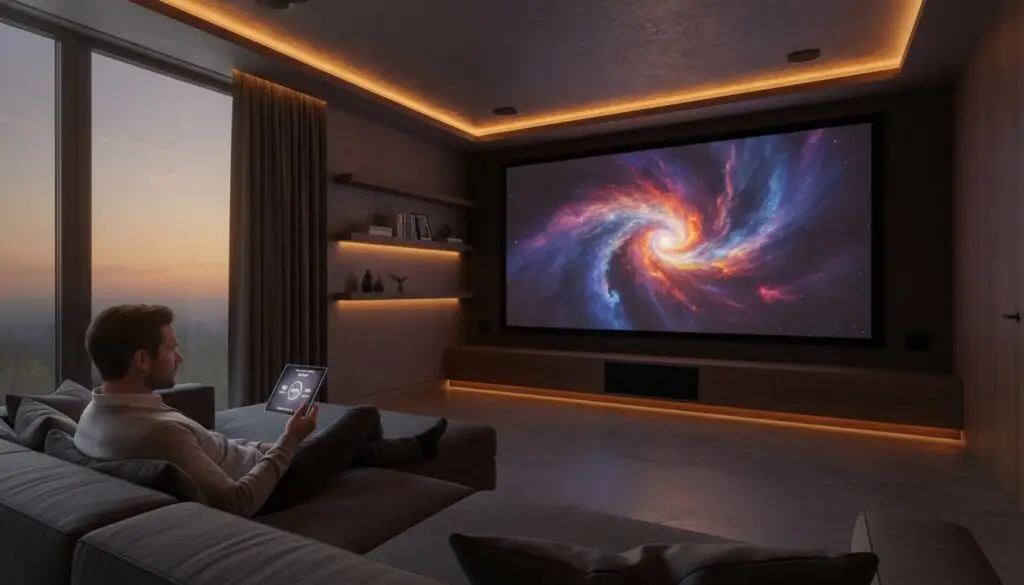
The most sophisticated residences in the capital aren’t defined by a collection of wireless gadgets; they’re defined by an engineered ecosystem that functions as a single, cohesive unit. If you’ve ever felt the exhaustion of toggling between ten different apps just to dim the lights and start a film, you’ve experienced the friction of disjointed technology. It’s a common frustration for Ottawa homeowners who seek luxury but end up with a fragmented system that feels like a second job to manage. True home theater automation Ottawa integration requires a shift in perspective, treating your entertainment space as a structural infrastructure project rather than a series of retail purchases.
This guide provides the roadmap to move from app fatigue to a master-crafted environment where lighting, climate, and security are managed through one intuitive interface. You’ll learn how a professional design-build approach eliminates the fear of obsolescence and ensures your wiring is ready for the latest standards in immersive audio and 8K video passthrough. We’ll explore how precise pre-construction scoping turns a basement renovation into a high-stakes investment that adds tangible value and daily convenience to your home.
Key Takeaways
- Distinguish between a fragmented collection of individual smart devices and a unified, professionally engineered ecosystem that eliminates the friction of app fatigue.
- Understand the necessity of structured cabling as the essential infrastructure for reliable home theater automation Ottawa and long-term property appreciation.
- Evaluate the performance of elite automation platforms to ensure your home technology operates as a seamless, intuitive extension of your daily lifestyle.
- Discover how the “Measured, Managed, MasterCrafted” framework integrates technical requirements into the pre-construction phase to prevent technical debt and costly retrofits.
- Learn to synchronize lighting, climate, and acoustics through a single interface by aligning specialized trades under a professional, design-build project management structure.
Beyond Smart Gadgets: Understanding True Home Theater Automation Integration
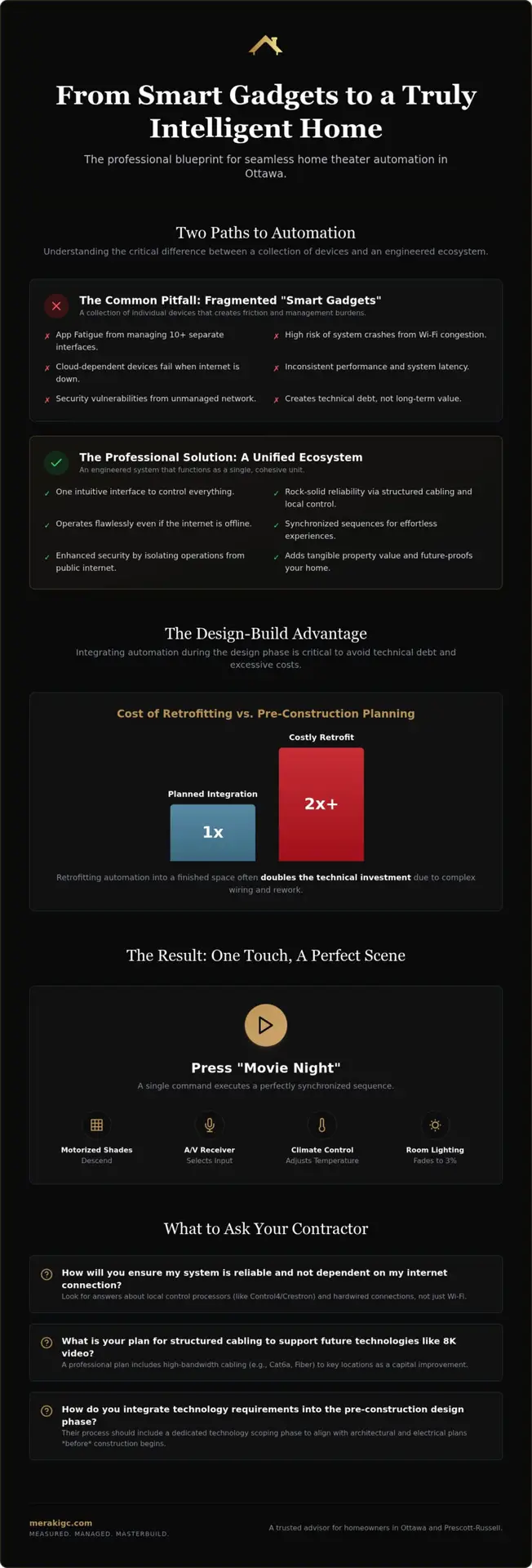
The distinction between a collection of independent smart gadgets and a unified ecosystem is the difference between a house that contains technology and a home that is truly intelligent. Many homeowners begin their journey by acquiring high-end components like a Marantz receiver or an Epson laser projector, only to find themselves trapped in a cycle of app fatigue. Managing ten separate interfaces for lighting, climate, and audio isn’t luxury; it’s a management burden. Sophisticated home theater automation Ottawa requires a central processor that acts as the singular intelligence of the room, harmonizing disparate hardware into a fluid, responsive environment.
Professional integration solves the “handshake” issues that plague consumer-grade setups. When you press “Movie,” the system doesn’t just turn on a screen. It executes a synchronized sequence: motorized shades descend, the Anthem MRX receiver selects the correct input, the climate control adjusts for the heat load of the equipment, and the lighting fades to a precise three percent glow. This level of execution demands a specialized focus on interoperability, ensuring that every piece of hardware communicates through a secure, high-performance protocol rather than relying on inconsistent cloud-based triggers.
The Hidden Risks of Fragmented Systems
Relying exclusively on Wi-Fi for automation is a common failure point in larger Ottawa residences. As the number of connected devices grows, unmanaged networks suffer from congestion and latency, leading to system crashes during peak usage. Most consumer devices are cloud-dependent, meaning your theater becomes unresponsive if the internet connection drops. A professionally engineered system prioritizes local control and structured cabling, providing a level of high-stakes reliability that consumer-grade Wi-Fi simply cannot match. This approach also mitigates security vulnerabilities, keeping your home’s internal operations isolated from the public internet.
Why Integration Must Begin in the Design Phase
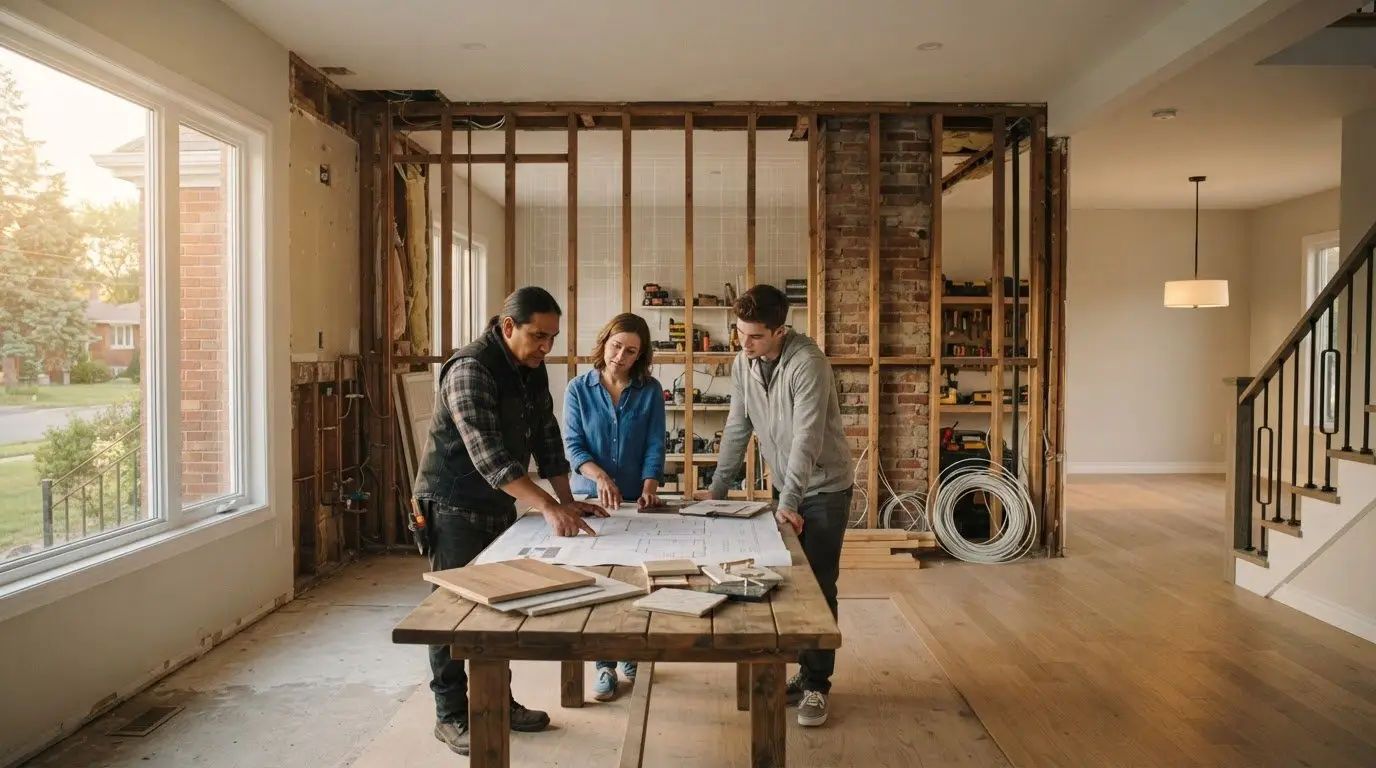
The cost of retrofitting automation into a finished basement often doubles the technical investment due to the complexity of running new wires behind closed walls. The Meraki General Contracting process emphasizes pre-construction scoping as the critical moment for automation design. By identifying technical requirements during the planning stage, we ensure that electrical circuits, HVAC routing, and structural supports are optimized for your specific technology stack. This proactive advisory prevents technical debt and ensures that your infrastructure remains future-proofed for the next generation of 8K media servers and architectural audio.
Engineering Your Smart Home: Infrastructure, Ecosystems, and Investment
High-performance home theater automation Ottawa is built on a foundation of physical infrastructure rather than ephemeral wireless signals. While consumer marketing often emphasizes the convenience of Wi-Fi, an institutional-grade renovation treats connectivity as a utility akin to plumbing or electrical. Relying on wireless protocols for high-bandwidth 8K streams or lossless audio leads to packet loss and system latency. For homeowners undertaking significant renovations, structured cabling represents a capital improvement that secures the home’s technological performance for decades. This engineered approach ensures that your investment remains a fluid extension of your lifestyle rather than a source of technical debt.
Selecting the right ecosystem is a high-stakes decision that dictates the long-term viability of your system. Platforms like Control4 and Crestron offer a level of reliability and global support that open-source or consumer-grade hubs cannot replicate. These professional ecosystems provide a unified interface, allowing for the precise execution of complex macro commands across lighting, climate, and security. In a design-build context, the smart home hub acts as the operational brain, requiring a dedicated environment with proper thermal management and power conditioning to ensure 24/7 uptime. If you are planning a comprehensive basement or whole-home transformation, our specialized integration services ensure these technical requirements are seamlessly embedded into your architectural plans.
The Backbone: Structured Wiring and Networking
Modern standards for 2026 demand an infrastructure capable of handling massive data throughput. Cat6a and fiber optic cabling are no longer optional for high-value renovations; they are essential for supporting the next generation of high-fidelity media servers and immersive audio processors. A professional installation centralizes these components in a dedicated equipment rack, utilizing active cooling to prevent hardware degradation. We also recommend the installation of leave-behind conduits during the pre-construction phase. This foresight allows for the easy pull of future cable types without the need to disturb finished surfaces, effectively future-proofing your residence against evolving technology cycles.
What This Means for You: Budgeting and ROI
In the competitive real estate markets of Ottawa and Prescott-Russell, a professionally integrated home automation system acts as a significant differentiator. Potential buyers increasingly prioritize “move-in ready” technology that is documented and professionally maintained. When budgeting for a $100,000 to $500,000 remodeling project, allocating resources toward invisible infrastructure often yields a higher return on investment than visible, trend-based gadgets. Focus your capital on “must-have” features like integrated lighting control and climate synchronization, which provide daily convenience and energy efficiency, rather than expensive technical gimmicks that offer little long-term utility.
The Design-Build Advantage: Integrating Automation into Your Ottawa Renovation
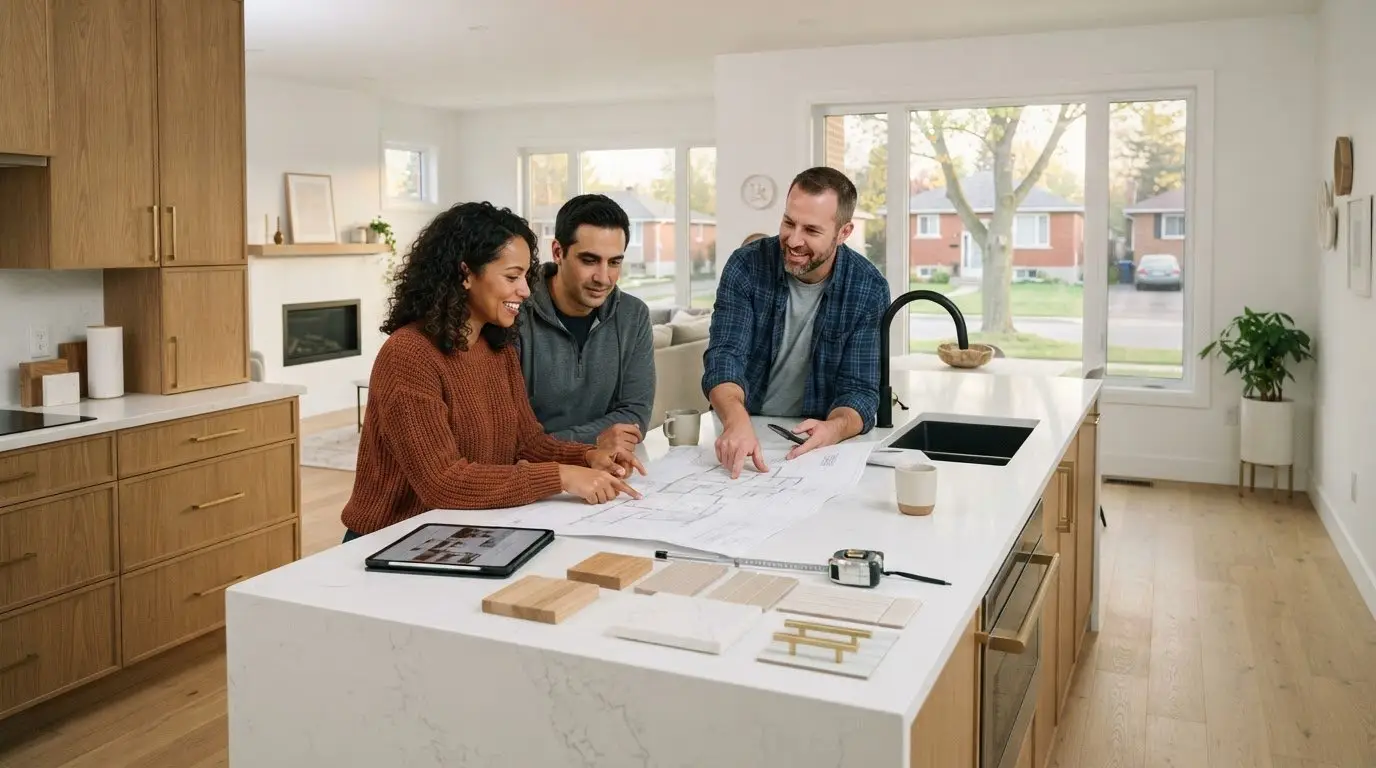
The successful execution of home theater automation Ottawa relies on a project management framework that treats technical systems as integral architectural elements. The Meraki General Contracting “Measured, Managed, MasterCrafted” process ensures that automation is never an afterthought. It begins with precise pre-construction scoping, where we coordinate the technical requirements of automation specialists with the structural work of electricians and HVAC technicians. This high-level alignment prevents the common friction points that typically arise when disparate trades operate in isolation, ensuring that your system is as reliable as it is sophisticated.
In the National Capital Region, automation serves a functional purpose that transcends mere entertainment. Integrating smart HVAC systems is critical for navigating Ottawa’s -30°C winters, where remote monitoring and automated climate adjustments act as a safeguard against frozen pipes and equipment failure. A unified system allows for proactive load shedding and precise humidity control, protecting both your high-end architectural finishes and your sensitive AV hardware from the extreme seasonal fluctuations of the Canadian climate. This level of environmental management requires a deliberate, engineered approach that standard general contracting often overlooks.
Solving the “Contractor Gap” in Home Automation
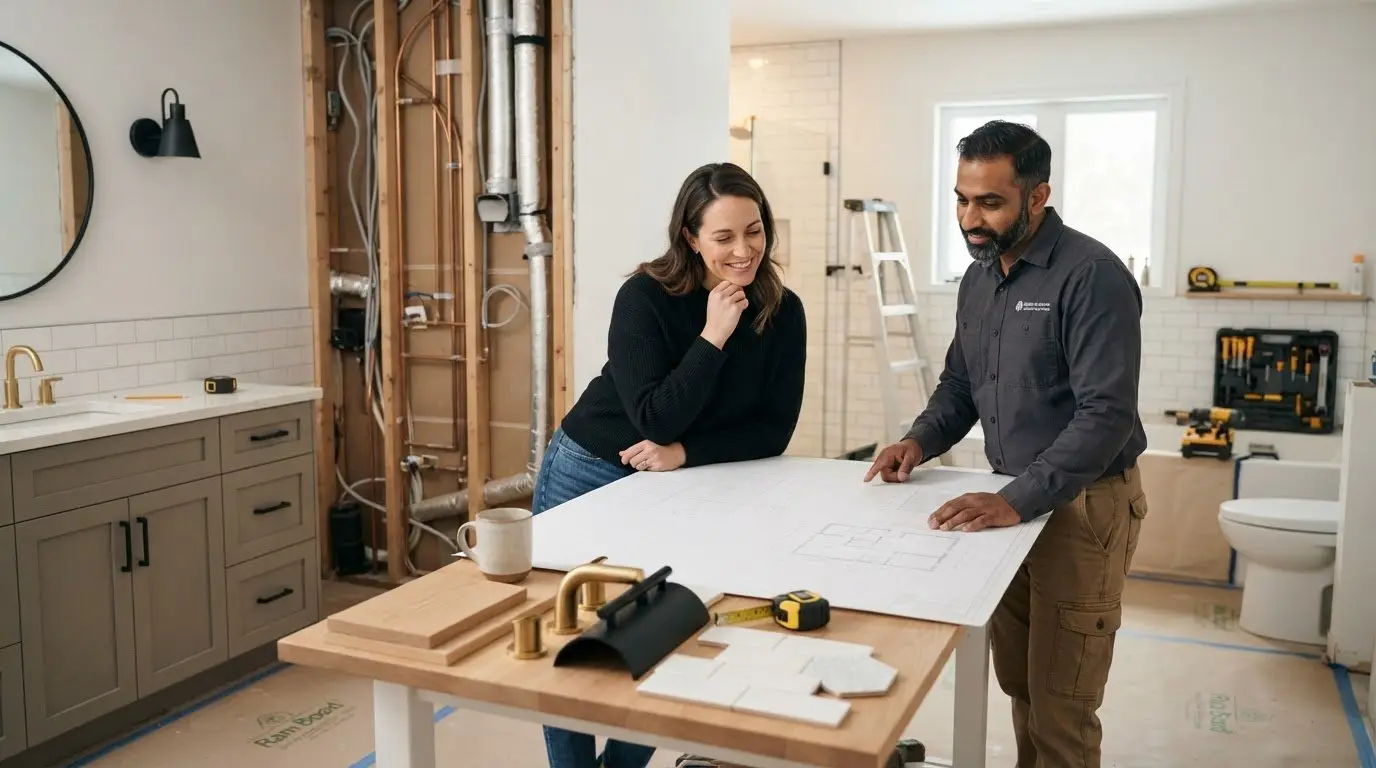
Most general contractors lack the specialized expertise required to plan for complex low-voltage wiring and signal interference. This “contractor gap” often results in poor equipment placement or inadequate cooling for dedicated server racks. When evaluating a builder, it’s vital to ask about their specific home automation experience and how they bridge the gap between architectural design and technical execution. Meraki General Contracting manages the intersection of luxury design and technical complexity by acting as a single point of accountability, ensuring every sensor and circuit is placed with precision before the first sheet of drywall is installed.
What to Watch For: Common Integration Pitfalls
Homeowners must remain vigilant against the “proprietary trap,” where systems are designed to lock you into a single service provider or hardware manufacturer. Our advisory focus remains on objective, fluid solutions that offer long-term flexibility. Furthermore, all technical work must strictly comply with the Ontario Electrical Safety Code to ensure both performance and insurance eligibility. Securing a comprehensive service plan for post-build support is equally essential, providing the necessary software updates that keep your home’s ecosystem operating at peak performance long after the renovation is complete.
Securing Your Technological Legacy
The transition from a fragmented collection of gadgets to a master-crafted environment requires more than just premium hardware; it demands a commitment to invisible infrastructure. By prioritizing structured cabling and professional-grade ecosystems, you ensure that your investment in home theater automation Ottawa remains a source of daily convenience rather than technical frustration. This strategic approach transforms your residence into a high-performance asset that is prepared for the next generation of media standards while providing seamless control over your environment today.
As Ottawa-based experts specializing in high-end renovations exceeding $100,000, we provide the specialized focus necessary to manage these complex technical intersections. Our clients benefit from data-driven pricing and live project dashboards; this level of transparency ensures your interests are protected throughout the design-build lifecycle. Your home deserves a technological foundation that is as sophisticated and reliable as its architecture. Book a Pre-Construction Consultation for Your Smart Home Project to begin engineering a space that reflects your standards of excellence. We look forward to helping you master your home’s potential.
Frequently Asked Questions
How much does a whole-home automation system cost to integrate in Ottawa?
Integration costs are determined by the complexity of the ecosystem and the specific tier of hardware selected. While entry-level components are accessible, a bespoke whole-home system reflects a significant capital allocation. Factors such as the number of controlled zones, the inclusion of architectural audio, and the depth of climate integration will influence the final investment. We recommend a detailed pre-construction scoping session to align technical requirements with your renovation budget.
Can I add home automation to an existing basement renovation project?
Integrating home theater automation Ottawa into an active basement project is most effective before the insulation and drywall phases. This window allows for the installation of structured cabling and dedicated power circuits without the expense of retrofitting. If your project is already underway, we can coordinate with your existing trades to embed the necessary infrastructure before the walls are closed.
What happens to my smart home system if I lose internet or power?
Professional systems are engineered to maintain core functionality during internet outages by prioritizing local network communication. Unlike consumer gadgets that rely on cloud servers, an integrated processor manages your lighting, climate, and security locally. For power interruptions, we recommend integrating an uninterruptible power supply (UPS) or a backup generator to protect sensitive hardware and ensure continuous uptime for your home’s central intelligence.
Is it better to use a wired or wireless system for a large renovation?
A wired infrastructure is the gold standard for any high-value renovation project. While wireless technology has improved, it remains susceptible to interference and bandwidth congestion in larger residences. Structured cabling ensures a dedicated, high-speed pathway for 8K video and lossless audio. This hardwired foundation provides the high-stakes reliability required for a seamless experience that wireless signals simply cannot guarantee.
What should I ask a contractor before hiring them for home automation integration?
You should inquire about their specific framework for trade coordination and their proficiency in professional ecosystems like Control4 or Crestron. Ask how they bridge the gap between architectural design and technical execution. A qualified partner will provide a clear roadmap for pre-construction scoping and offer a comprehensive service plan to manage your system after the physical renovation is complete.
Will home automation integration significantly increase my home value in Prescott-Russell?
Professional automation integration serves as a powerful differentiator in the luxury real estate markets of Ottawa and Prescott-Russell. Modern buyers prioritize residences that offer sophisticated, move-in-ready technology and energy-efficient climate management. By transforming a standard renovation into an intelligent environment, you increase the property’s appeal to an elite demographic that values both daily convenience and future-proofed infrastructure.

Article by
~ Jason Bourguignon
Jason has been passionate about building homes from a young age, starting his first successful construction company at age 21. With experience across nearly every sector of the industry, he brings a hands-on understanding of the entire building process. For over two decades, he has managed hundreds of custom home builds, additions, and renovations with some single projects exceeding $2.5M. Jason does not just focus on construction, but also helps homeowners create spaces they truly call home.
Disclaimer
The information in this article is provided for general educational purposes only and is based on typical renovation scenarios in Ontario. Every project is unique, and actual costs, timelines, and requirements may vary. This content does not constitute professional, legal, or engineering advice. We recommend consulting with a qualified contractor or specialist for your specific project.