What if the C$30,000 you invest in your Russell renovation today becomes technologically obsolete before your first housewarming party? Most homeowners we speak to in the Ottawa area share this exact anxiety, feeling caught between the lure of modern convenience and the fear of escalating “scope creep” costs. Achieving a truly sophisticated home automation system integration requires more than just buying the latest gadgets; it demands a structured, institutional approach to planning that prioritizes longevity and reliability over temporary trends.
It’s natural to feel overwhelmed by the choice between simple DIY devices and professional-grade systems. We promise to help you navigate these complexities by providing a clear roadmap for a seamless, “invisible” technology experience that respects your budget. This guide explores exactly what these systems cost in the 2026 market, which technical pitfalls commonly lead to budget overruns, and the essential questions you must ask your contractor to ensure your investment remains a high-performing asset for years to come.
Key Takeaways
- Distinguish between fragmented retail gadgets and a sophisticated, institutional-grade backbone that provides unified control over your home’s lighting, HVAC, and security.
- Understand the financial landscape of home automation system integration, which typically accounts for 5-10% of a bespoke renovation budget in the Ottawa region.
- Identify the critical risks of “island” systems and network vulnerabilities that often lead to technical obsolescence and unforeseen capital outlays.
- Discover how a structured design-build process and real-time dashboards ensure your project remains seamless, transparent, and aligned with your lifestyle objectives.
- Gain the specific insights and questions needed to vet contractors, ensuring your Russell home is equipped with a resilient infrastructure built for the standards of 2026.
Understanding Home Automation System Integration: Beyond the Gadgets
Why Infrastructure Matters in Ottawa’s Unique Climate
In the Ottawa Valley, our homes must withstand extreme temperature swings. Your HVAC integration must be robust enough to manage a shift from -30°C in January to +30°C in July without a glitch. We prioritize hardwired backbones using Cat6a or Fiber cables because wireless signals often struggle to penetrate the thick stone or brick builds common in Russell and Manotick. A physical connection ensures your security and climate systems remain reliable during the most demanding weather events.
What This Means for You
Successful integration is technology that serves the architecture, not the other way around. To avoid budget overruns and technical delays, your automation strategy must be finalized during the pre-construction scoping phase. This allows us to identify potential risks, such as signal dead zones or hardware incompatibilities, before the walls are closed. It ensures your home automation system integration is a fixed asset that adds long-term value to your property rather than a collection of soon-to-be-obsolete gadgets. For a deeper look at the specific infrastructure required for a future-proof approach to home automation in Ottawa, our homeowner’s guide covers the critical planning steps in detail.
The Financials and Pitfalls of Smart Home Integration
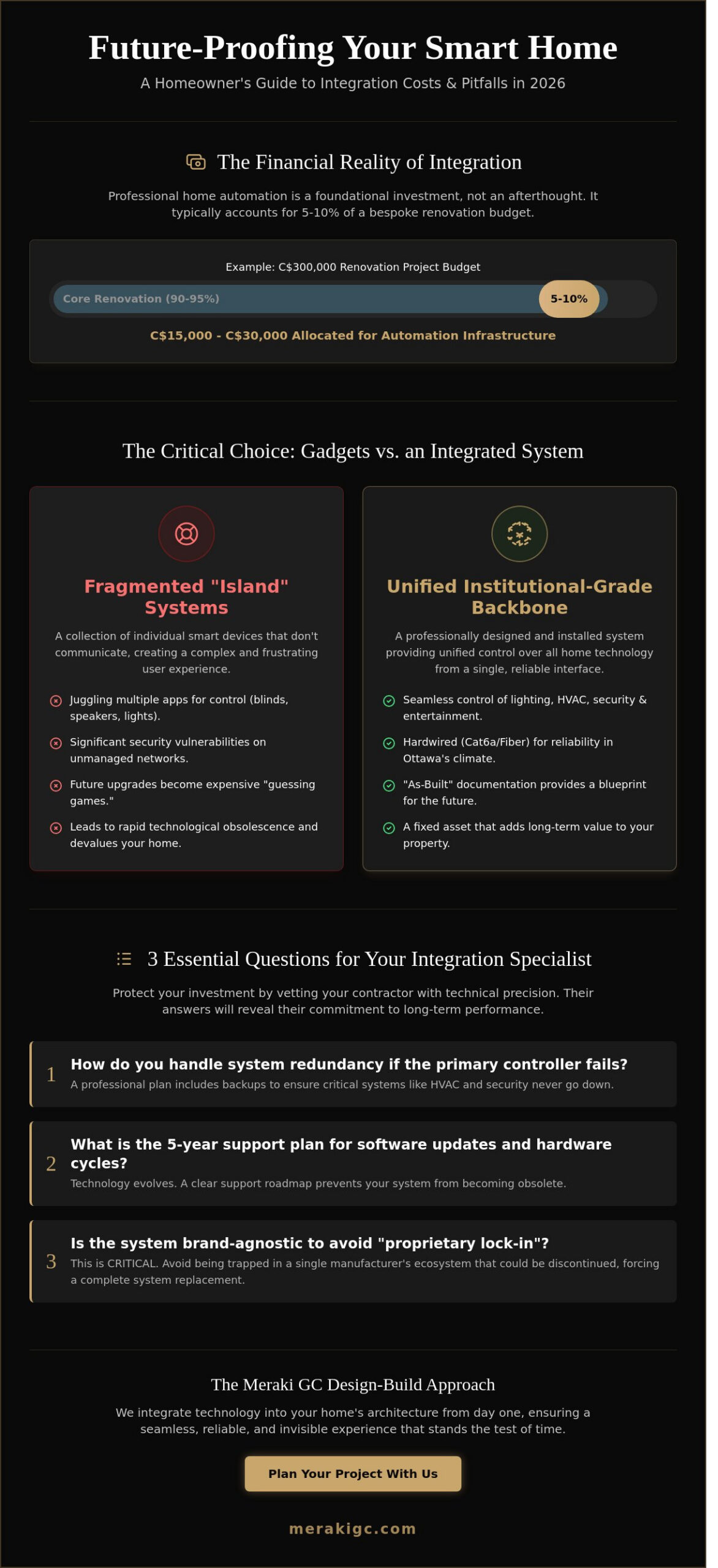
When you’re planning a major renovation in Ottawa, the technical infrastructure requires as much foresight as the structural engineering. Most homeowners we speak to are surprised to learn that professional home automation system integration typically accounts for 5% to 10% of a total renovation budget. For a C$300,000 project, this means allocating C$15,000 to C$30,000 to ensure your home’s digital ecosystem is seamless. This isn’t just about buying gadgets; it’s about the labor and expertise required to make those gadgets work as a single, unified entity.
Here’s where projects go wrong: the rise of “island” systems. This happens when individual components like smart blinds, speakers, and thermostats don’t talk to each other, forcing you to juggle ten different apps. Beyond the frustration, there are significant Smart Home Security Risks if your network isn’t professionally hardened. You should watch for contractors who don’t provide a detailed wiring schedule or “As-Built” documentation. Without these digital blueprints, future repairs or upgrades become expensive guessing games. We mitigate these risks through our Measured, Managed, MasterCrafted approach, which eliminates cost escalations by finalizing every technical detail before the first cable is pulled.
Risk Mitigation: What to Ask Your Integration Specialist
To protect your investment, you need to vet your specialist with technical precision. Ask these three essential questions during your initial consultation:
- How do you handle system redundancy if the primary controller fails?
- What is the 5-year support plan for software updates and hardware cycles?
- Is the system brand-agnostic?
Avoid “proprietary lock-in” at all costs. This is a common trap where homeowners are forced into a single manufacturer’s ecosystem for life, leaving you stranded if that company goes out of business or stops supporting your hardware.
Integrating Technology into Luxury Spaces
Investing in integration early prevents the “rip and replace” cycle that plagues many DIY smart homes. By budgeting 5-10% for a professional home automation system integration and demanding full documentation, you ensure your home remains an asset rather than a technical liability. It’s about building a foundation that is as reliable as the plumbing in your walls. Homeowners across the Prescott-Russell area who want to avoid app fatigue and fragmented systems will find our comprehensive guide to smart home automation in Ottawa an essential resource for understanding how to plan a bespoke, future-proof installation from the ground up.
This foundational approach is especially important for homeowners looking to include professional-grade creative spaces, such as those required for Remote Podcast Recording and Production, within their residential layout.
The Meraki Approach: Seamless Integration through Design-Build
Meraki General Contracting treats home automation system integration as an architectural discipline rather than a series of isolated gadgets. We merge the precision of traditional craftsmanship with the complexity of modern digital infrastructure. Most homeowners we speak to in Ottawa and Russell worry about their $200,000 renovation becoming a technical nightmare once the drywall is closed. We solve this by using live dashboards. These tools provide you with real-time visibility into technical milestones and the status of your budget in C$. You will always know where your investment stands.
Our handover process is deliberate and educational. We don’t just hand you a tablet and walk away. We spend the time necessary to ensure you feel confident operating every scene, sensor, and circuit we’ve built. In the high-stakes world of luxury transformations, we act as your trusted advisor. We ensure your home functions as a single, cohesive unit rather than a collection of competing technologies.
Why Proactive Communication is the Core of Smart Builds
Technical debt ruins many high-end projects. This happens when systems are installed without a master plan, leading to expensive retrofits later. Our Measured, Managed, MasterCrafted process prevents this by identifying conflicts early. We look for overlaps between electrical runs, HVAC ducting, and your automation hardware before the first wall is opened. This level of coordination prevents the common 15% budget overruns that occur when contractors don’t talk to each other. We manage the friction so you don’t have to.
Next Steps for Your Smart Renovation
Securing Your Smart Investment in Russell
A truly intelligent home isn’t built by adding gadgets after the drywall is up. It requires a deliberate strategy that aligns with your lifestyle and your long-term property value. Most homeowners we speak to in Russell and the wider Ottawa area worry about their technology becoming obsolete or failing to communicate across platforms. Successful home automation system integration solves these issues by treating technology as a core utility, much like plumbing or electrical systems.
For renovations ranging from C$100,000 to C$500,000, we apply our Measured, Managed, MasterCrafted proprietary process to ensure every detail is accounted for before construction begins. This approach provides the institutional reliability of a large firm with the high-touch service of a boutique partner. We focus on transparency and structured planning to protect your budget from the common pitfalls of smart home projects. To understand which smart home features deliver the best return on investment in 2026, our integration guide breaks down the systems that add genuine value without the risk of costly obsolescence. You’ll gain a home that’s sophisticated, reliable, and ready for whatever 2026 brings.
Take the first step toward a seamless renovation. Book a Pre-Construction Consultation for Your Smart Renovation today. Your vision deserves a foundation of expert execution and quiet confidence.
Frequently Asked Questions
How much does a professional home automation system cost in Ottawa?
A professional home automation system integration in Ottawa typically starts at C$15,000 for foundational lighting and security, while comprehensive solutions for larger properties often range from C$50,000 to C$150,000. These figures reflect the bespoke hardware and precision programming required for a seamless experience. Most homeowners we speak to find that labor and structured wiring account for 30 percent of the total investment, ensuring the system remains stable and reliable over time.
Can I integrate smart features into an older home in Russell?
What happens to my home automation system if the internet goes down?
Your core home automation system integration will continue to function locally because professional-grade controllers process commands on-site rather than relying on a cloud connection. This means your lighting scenes, pre-set climate schedules, and security protocols remain 100 percent operational without an external signal. While you’ll lose remote access via your smartphone and music streaming services, your physical wall keypads and automated timers won’t fail during a service provider outage.
How do I ensure my smart home technology doesn’t become obsolete?
Ensuring longevity requires a foundation of Category 6 structured cabling and modular hardware that supports consistent firmware updates. Industry data shows that systems built on closed, proprietary loops have a 40 percent higher replacement rate within five years compared to open-platform ecosystems. We recommend choosing hardware with a documented 10 year support lifecycle. This strategy allows you to swap individual components as technology evolves without needing to replace the entire backbone of your home. For a comprehensive overview of which smart home features Ottawa homeowners should prioritize in 2026, our integration guide outlines the open-platform systems that best support long-term flexibility and value.

Article by
~ Jason Bourguignon
Jason has been passionate about building homes from a young age, starting his first successful construction company at age 21. With experience across nearly every sector of the industry, he brings a hands-on understanding of the entire building process. For over two decades, he has managed hundreds of custom home builds, additions, and renovations with some single projects exceeding $2.5M. Jason does not just focus on construction, but also helps homeowners create spaces they truly call home.
Disclaimer
The information in this article is provided for general educational purposes only and is based on typical renovation scenarios in Ontario. Every project is unique, and actual costs, timelines, and requirements may vary. This content does not constitute professional, legal, or engineering advice. We recommend consulting with a qualified contractor or specialist for your specific project.