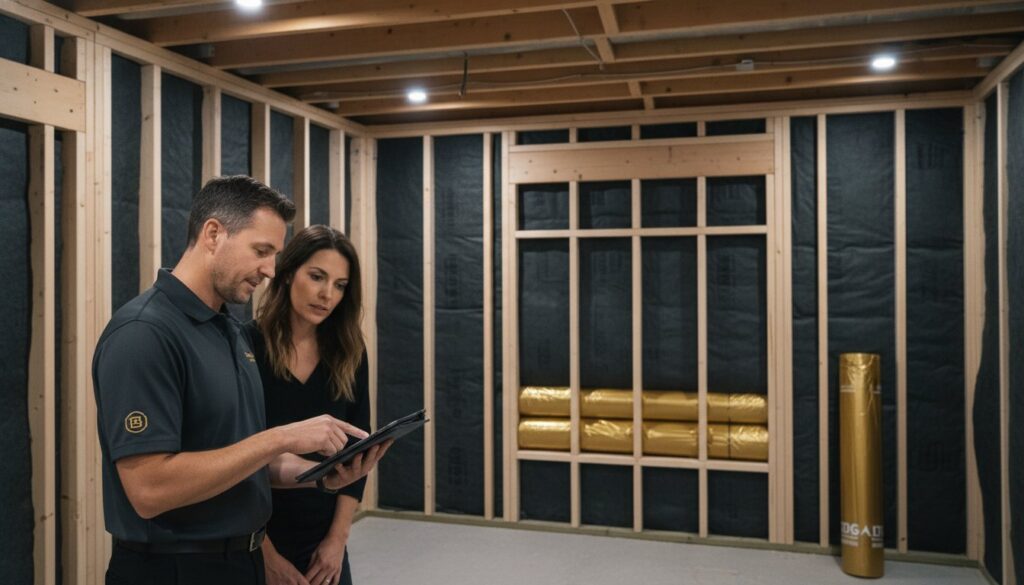
What if the most expensive insulation you can buy still lets your teenager’s favorite action movie shake the master bedroom floor? Most homeowners we speak to in the Russell area believe that standard soundproofing is just about adding thickness to the walls. In reality, sound behaves like water; it finds every structural gap and vibrates through the very studs of your home. If you are planning a soundproof basement home theater Russell families can enjoy without interruption, you have likely realized that traditional renovation methods often fail to stop the low frequency rumble of a subwoofer from traveling upstairs.
We understand the anxiety of investing significant capital into a project only to realize the acoustic engineering was an afterthought. You deserve a cinema-grade experience that remains entirely contained within its own space. This 2026 guide teaches you how to employ a “room-within-a-room” strategy to achieve a Sound Transmission Class rating of 60 or higher, which is the professional standard for true isolation. We will also cover how to avoid the common pitfalls of unpredictable renovation costs and how to vet contractors who actually understand the physics of sound.
What this means for you is a managed, transparent process where the technical details are handled by experts. By focusing on proper decoupling and airtight sealing, you can achieve a flawless entertainment space and total peace of mind without any budget surprises.
Key Takeaways
- Learn the critical difference between soundproofing for structural isolation and acoustic treatment for internal audio quality.
- Discover how a “room-within-a-room” engineering approach is essential for a soundproof basement home theater Russell homeowners can enjoy without disturbing the rest of the house.
- Identify the unique structural challenges of Russell basements, including how to manage sound leakage through concrete floors and existing HVAC systems.
- Uncover the “weak link” pitfalls, such as standard recessed lighting and unsealed gaps, that can destroy your sound barrier’s effectiveness.
- Understand why structured pre-construction planning is the only way to ensure a cinema-grade result without the stress of unpredictable budget overruns.
Understanding Sound Control in Russell Basement Renovations
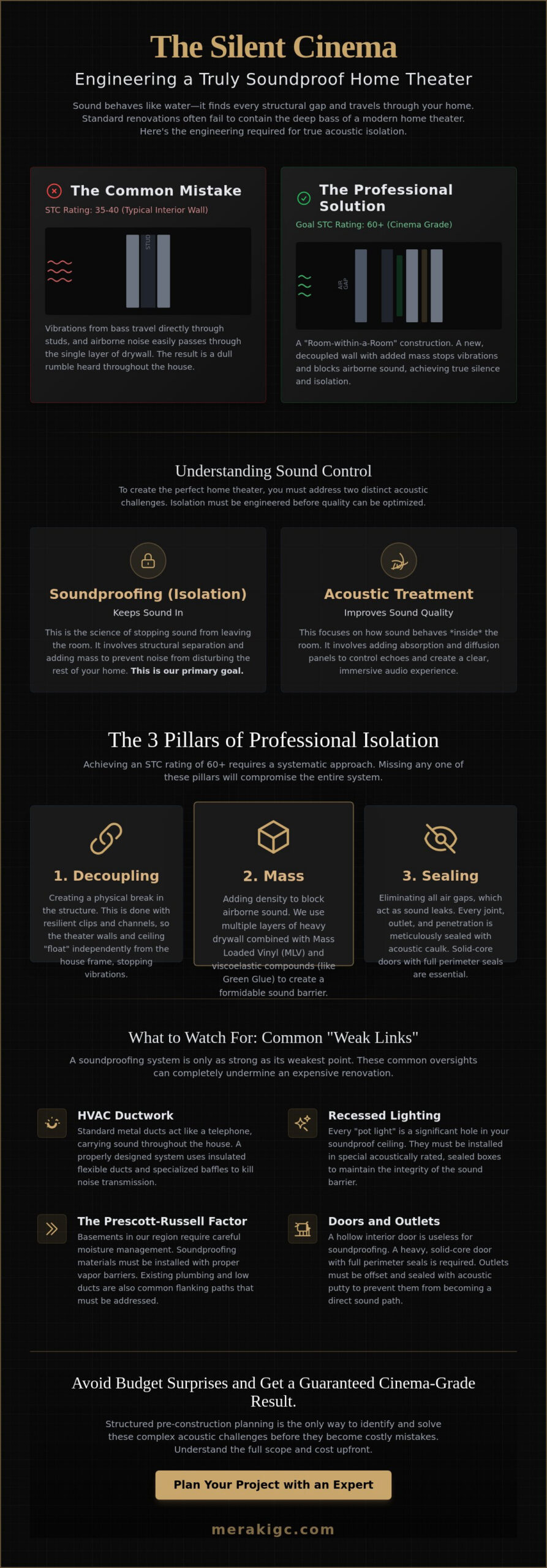
Most homeowners we speak to in the Prescott-Russell area begin their project with a simple goal: they want to turn up the volume without waking the children upstairs. However, there is a significant technical gap between acoustic treatment and true soundproofing. Acoustic treatment focuses on how sound behaves inside the room, such as reducing echoes or improving clarity. Soundproofing is the science of isolation, which prevents sound from escaping the room entirely. Designing a high-performance soundproof basement home theater Russell families can enjoy requires addressing both, but isolation is where the engineering must start.
Sound Transmission Class (STC) is the standard integer rating used to measure how effectively a building partition reduces the transmission of airborne noise between adjacent rooms.
In our experience, the concrete slabs common in Russell basements are often misunderstood. While concrete is dense, it is also highly reflective and can actually help low-frequency vibrations travel through the rest of the house frame. Most homeowners we speak to underestimate how easily sub-bass frequencies vibrate through floor joists and emerge as a dull thud in the master bedroom. This is why a standard renovation approach usually fails to provide the silence you expect.
Airborne vs. Structure-Borne Noise
Stopping noise requires a dual strategy. Airborne noise, like dialogue or movie scores, is effectively blocked by adding mass and ensuring airtight seals around doors and fixtures. Structure-borne noise is more difficult to manage. This occurs when sound energy physically vibrates the studs and joists of your home. To combat this, you must apply the principles of soundproofing by decoupling the theater walls from the existing house structure. If the theater walls don’t touch the house frame, the vibration has nowhere to go.
The Russell Basement Factor: Moisture and Mechanicals
Local conditions in Ontario demand specific attention to moisture. You cannot simply pack a wall with sound-dampening material without considering the moisture-resistant barriers required for basement foundations. Here’s where projects go wrong: contractors often overlook “flanking paths.” These are the hidden routes sound takes through shared HVAC ductwork and plumbing stacks. In a typical Russell basement, low-hanging ducts act like a megaphone, carrying theater noise directly to the floors above. Addressing these mechanical gaps is a core part of our structured planning process, ensuring the technical isolation is as robust as the visual design.
Engineering the Silent Cinema: Decoupling, Mass, and Dampening
Engineering a soundproof basement home theater Russell residents can rely on requires more than just thicker insulation. It demands a structural shift. The most effective method is the “Room-within-a-Room” concept. This involves building a secondary wall and ceiling structure that remains physically separate from the original foundation and floor joists. By creating this gap, you prevent sound energy from having a direct path to the rest of your home. Without this physical separation, even the most expensive materials will fail to stop low-frequency vibrations.
Specialized materials like Mass Loaded Vinyl (MLV) and acoustic drywall provide the necessary density to block sound without consuming excessive square footage. However, mass alone isn’t enough. You must also address dampening. Using visco-elastic compounds between layers of drywall allows the structure to convert sound vibrations into microscopic amounts of heat. This process is one of the most effective ways to cut noise pollution at home, ensuring your cinema stays silent to the outside world.
The Three Pillars of Professional Isolation
- Decoupling: We use resilient clips or hat channels to break the physical connection between the drywall and the wall studs. This stops high-energy bass from vibrating through the frame.
- Mass: Installing multiple layers of dissimilar materials helps break resonant frequencies that a single layer might let through.
- Sealing: Every air gap is a sound leak. We use acoustic caulk to seal electrical outlets, door sweeps, and light fixtures to maintain the integrity of the sound barrier.
What it Costs: Budgeting for High-Performance Soundproofing
Most homeowners find that professional soundproofing adds roughly 15% to 25% to their total basement finishing budget. While this is a notable investment, the long-term value is found in the performance. Fixing poor acoustic planning after the drywall is finished can be three times more expensive than doing it right the first time. If you are beginning the design phase, our custom home theater design and build services focus on getting these technical details right from day one, protecting your investment from costly retrofits.
Avoiding the Pitfalls: What Can Go Wrong in Your Russell Theatre Build
Even the most meticulous planning can be undone by a single oversight. In the industry, we call this the “Weak Link” theory. A soundproof barrier is only as strong as its smallest opening. A single unsealed 1-inch gap, perhaps around a poorly fitted door or an electrical box, can reduce a wall’s soundproofing effectiveness by 50%. Here’s where projects go wrong: many contractors treat a soundproof basement home theater Russell project as a standard drywall job with extra insulation. They don’t realize that standard mineral wool insulation is just one component; it isn’t a standalone soundproofing solution.
Most homeowners we speak to are surprised to learn that standard recessed lighting creates a “Swiss cheese” effect in their acoustic barrier. These fixtures provide a direct path for noise to bleed into the bedrooms above. Truly engineering a superior acoustic environment requires specialized light back-boxes and airtight seals that maintain the integrity of your “room within a room.” Before you sign a contract, ask your builder specifically: “How do you plan to handle the HVAC supply and return air without creating a sound bridge?” If they don’t have a plan for acoustic baffles or “Z-ducts,” your isolation will fail the moment the furnace kicks on.
What This Means for You: The Meraki Process
Our “Measured, Managed, MasterCrafted” approach is designed to eliminate these technical risks. We use data-driven scoping during the design phase to ensure acoustic goals are met before construction starts. This level of transparency in pricing prevents the “escalating cost” trap common in basement renovations. You can follow every milestone through our live dashboard by exploring our process, which keeps communication clear and professional throughout the build.
The Trusted Advisor Perspective
We often advise homeowners to prioritize structural isolation over the latest 8K projector. Electronics can be upgraded easily; structural soundproofing cannot. We also ensure your soundproofed space remains compliant with local Russell permitting and Ontario Fire Code egress requirements. It’s about finding the balance between total silence and absolute safety. For a partnership built on honesty and specialized focus, you can learn more about why Meraki is the right choice for high-stakes residential investments.
Securing Your Cinema Investment
Achieving a professional-grade soundproof basement home theater Russell families can enjoy for years requires moving beyond standard renovation habits. We’ve explored how the physics of decoupling and the strategic use of mass are essential to stop vibrations from reaching the bedrooms upstairs. You now understand that avoiding “weak links,” such as unsealed gaps or improper HVAC routing, is just as important as the materials you choose. These technical details are the difference between a room that looks like a theater and one that performs like a cinema.
At Meraki, we bring local Prescott-Russell expertise to every project, specializing in high-end residential transformations between $100K and $500K. Our proprietary Measured, Managed, MasterCrafted process ensures your project stays on track and within budget through meticulous pre-construction planning. We focus on building trust through transparency, so you don’t have to worry about hidden costs or technical failures. If you’re ready to begin engineering your ideal entertainment space, you can Request a Data-Driven Quote for Your Russell Home Theatre. Your perfect cinema experience is within reach when you start with a foundation of expert planning.
Frequently Asked Questions
How much does it cost to soundproof a basement home theatre in Russell?
The total investment for soundproofing depends on the level of isolation you require and the structural complexity of your basement. Most homeowners find that professional acoustic engineering adds a percentage to their overall renovation budget. Factors like the number of layers of specialized drywall, the use of visco-elastic dampening compounds, and the complexity of decoupling the ceiling will influence the final cost. It’s best to plan for these expenses during the pre-construction phase to avoid surprises.
Can I soundproof my basement theatre without losing ceiling height?
You will likely lose a small amount of height, but specialized low-profile decoupling systems can keep this loss to a minimum. While traditional “room-within-a-room” methods can take several inches, using resilient clips and hat channels usually only reduces height by about 2 inches. This is a necessary trade-off to stop theater noise from vibrating through the floor joists and emerging in the rooms directly above your entertainment space.
Is Roxul Safe n Sound enough to stop theatre noise from reaching the floor above?
Insulation alone is not enough to stop low-frequency bass from traveling through your home’s frame. While mineral wool products are excellent for absorbing sound within a wall cavity to prevent echoes, they don’t provide the structural decoupling needed for a soundproof basement home theater Russell homeowners expect. To truly isolate the room, you must combine insulation with physical separation and significant mass to break the path of the sound waves.
What is the best type of door for a soundproof home theatre?
A heavy, solid-core door is the minimum requirement for any professional theater project. Standard hollow-core doors are lightweight and act like a drum, allowing sound to pass through easily. For superior results, we recommend an exterior-grade solid door equipped with an automatic drop seal and heavy-duty weather stripping. This creates an airtight seal, ensuring the door doesn’t become the weak link in your acoustic barrier.
Do I need a special permit for building a soundproof room in my basement?
You don’t need a specific “soundproofing permit,” but you must obtain a standard building permit for any basement renovation in the Prescott-Russell area. Local building codes are very specific about fire safety, ventilation, and emergency exits. When building a soundproof room, you must ensure your isolation layers don’t interfere with required egress windows or the placement of smoke and carbon monoxide detectors according to the Ontario Building Code.
What happens if I don’t soundproof my home theatre?
Without proper soundproofing, the high-energy sound from your movies will likely disturb every other room in your house. Most homeowners we speak to regret skipping this step because retrofitting acoustic isolation after the walls are finished is significantly more expensive. You’ll often find yourself turning the volume down to avoid complaints, which ultimately defeats the purpose of investing in a high-performance cinema-grade experience in the first place.

Article by
~ Jason Bourguignon
Jason has been passionate about building homes from a young age, starting his first successful construction company at age 21. With experience across nearly every sector of the industry, he brings a hands-on understanding of the entire building process. For over two decades, he has managed hundreds of custom home builds, additions, and renovations with some single projects exceeding $2.5M. Jason does not just focus on construction, but also helps homeowners create spaces they truly call home.
Disclaimer
The information in this article is provided for general educational purposes only and is based on typical renovation scenarios in Ontario. Every project is unique, and actual costs, timelines, and requirements may vary. This content does not constitute professional, legal, or engineering advice. We recommend consulting with a qualified contractor or specialist for your specific project.