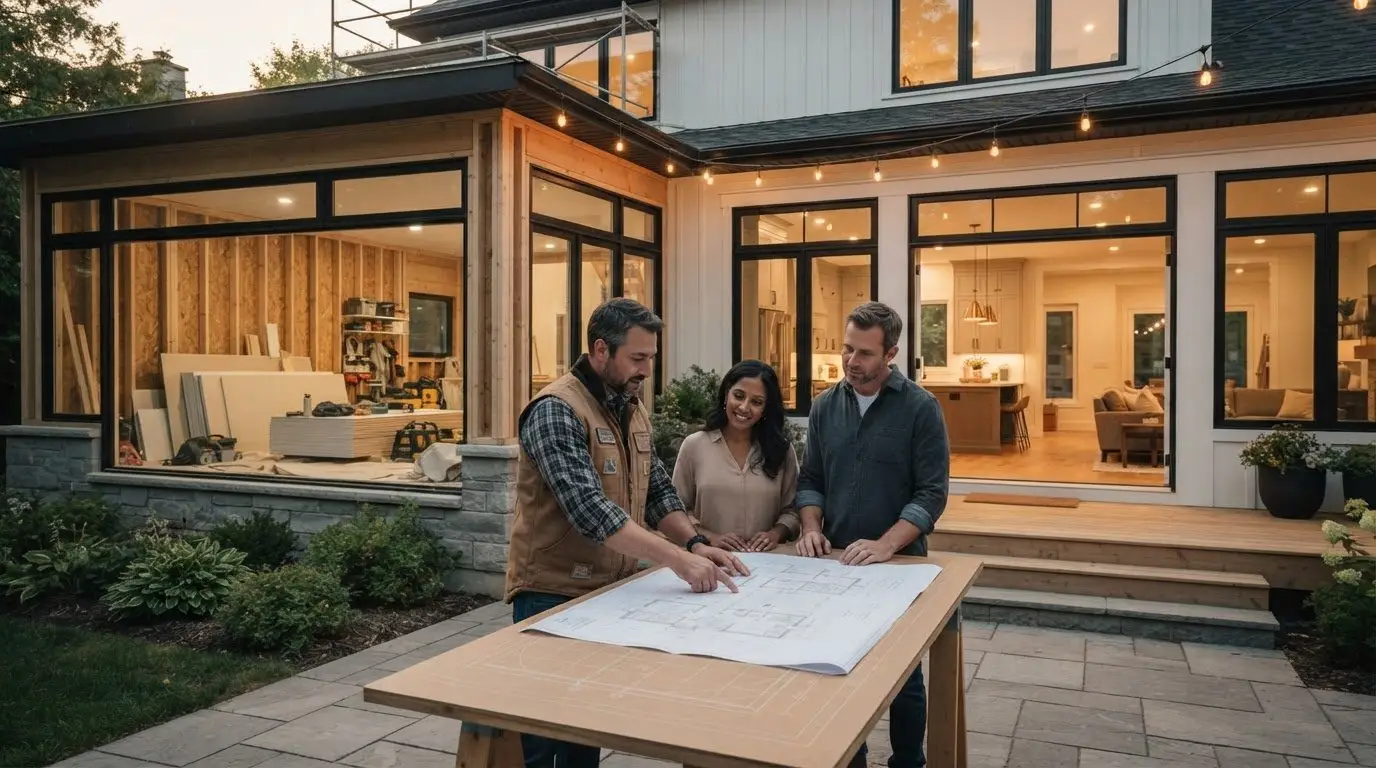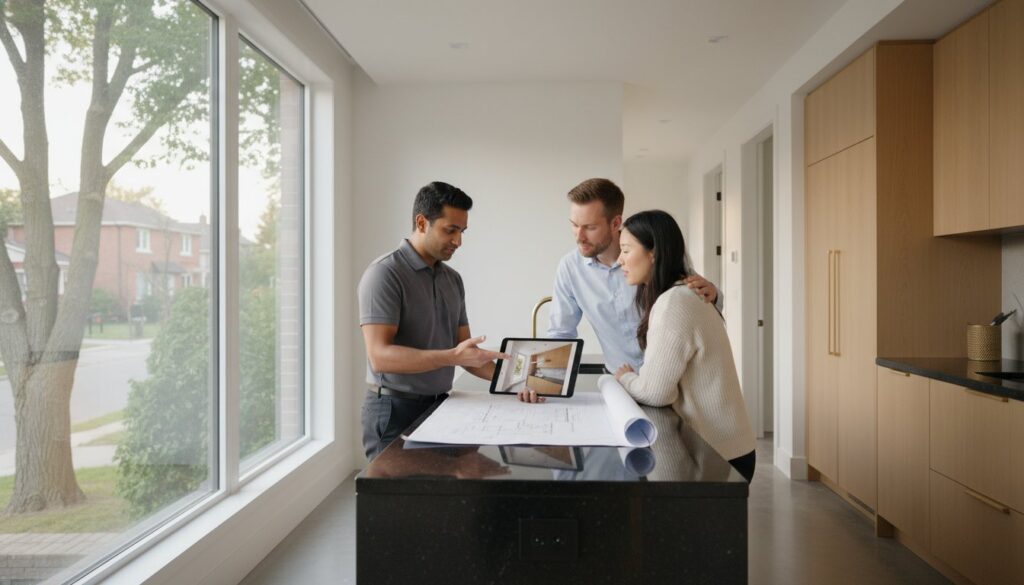
A $200,000 renovation budget shouldn’t be a moving target, yet many homeowners in Ottawa accept budget creep as an unavoidable part of the journey. You’ve likely heard the stories of projects that start with a beautiful set of drawings but end with a final bill that’s significantly higher than the initial estimate. It’s exhausting to manage the friction between a designer’s vision and a builder’s reality while your family life is stuck in a state of perpetual construction. Most homeowners we speak to just want the certainty that their investment is being handled with professional precision and honest transparency.
The design-build process for homeowners acts as a strategic safeguard against these common pitfalls. By integrating design and construction under one roof, you eliminate the finger-pointing that leads to delays and unexpected costs. This guide will show you how this model provides a predictable, data-driven experience for high-value renovations between $100,000 and $500,000. We’ll explore how structured planning and a single point of contact ensure your finished home matches the 3D rendering exactly, keeping your project on track and your budget intact.
Key Takeaways
- Learn how a single point of accountability removes the friction between design and construction to keep your renovation timeline on track.
- Understand why the design-build process for homeowners prevents the trap where beautiful architectural plans often exceed realistic construction budgets.
- Discover the data-driven steps involved in pre-construction scoping that eliminate financial surprises long before the first wall is removed.
- Explore how integrating specialized spaces like custom home theaters and smart automation adds high-tier value to your Ottawa property.
- See how this integrated model typically reduces change order costs by 10% to 15% compared to traditional renovation methods.
Understanding the Design-Build Process: Why One Contract Changes Everything
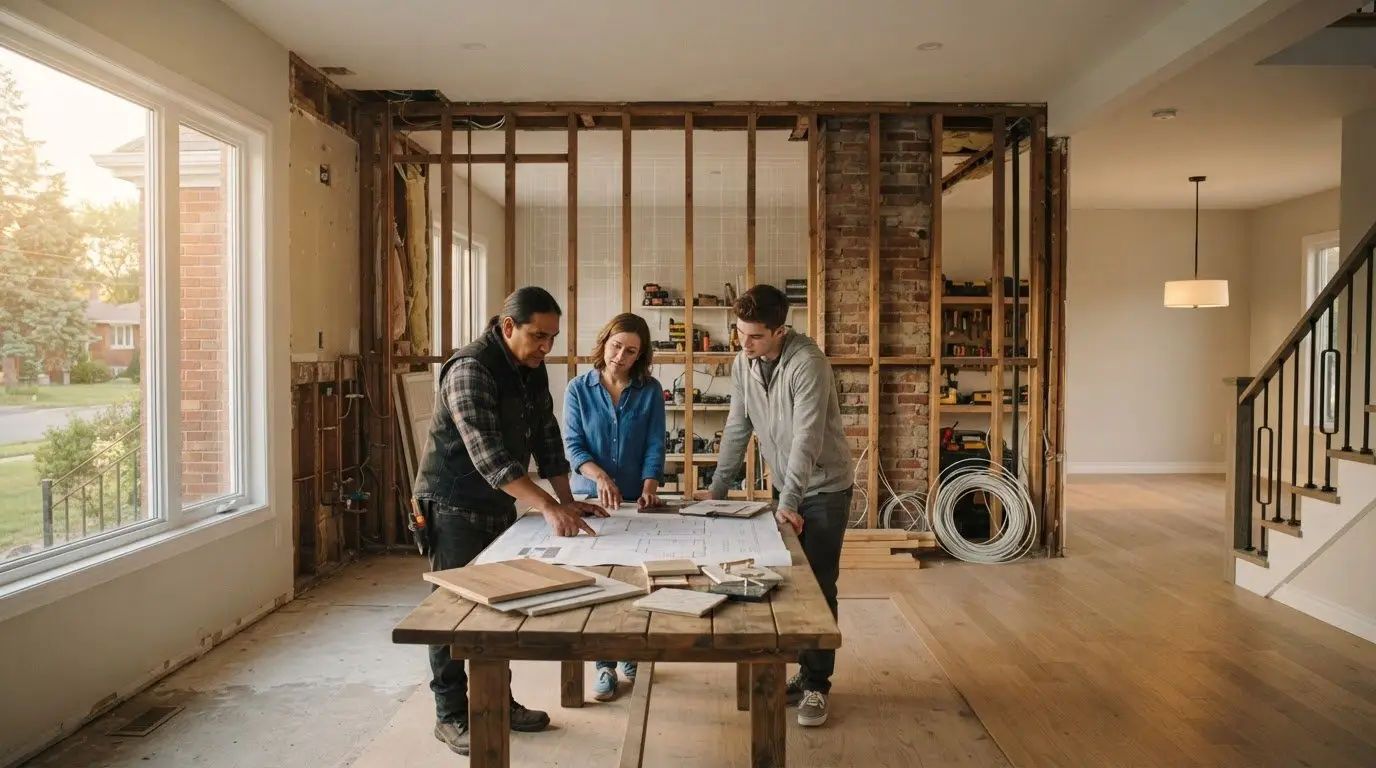
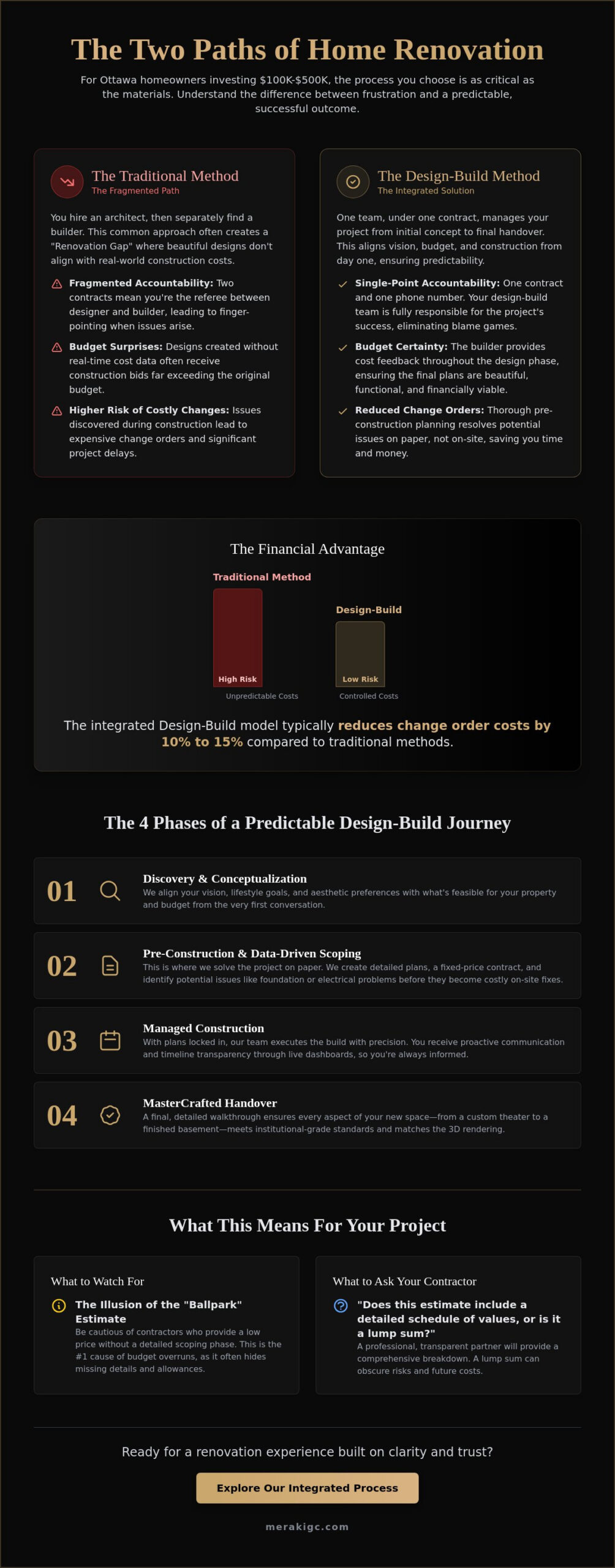
The design-build process for homeowners is a collaborative delivery system that aligns architectural vision with construction reality. In traditional renovation models, you might hire an architect to draw plans and then search for a contractor to build them. This creates a fragmented experience where you hold two separate contracts and often act as a referee between two different companies. By Understanding the Design-Build Model, you can see how integrating these roles into one team provides a more streamlined and reliable path for your investment.
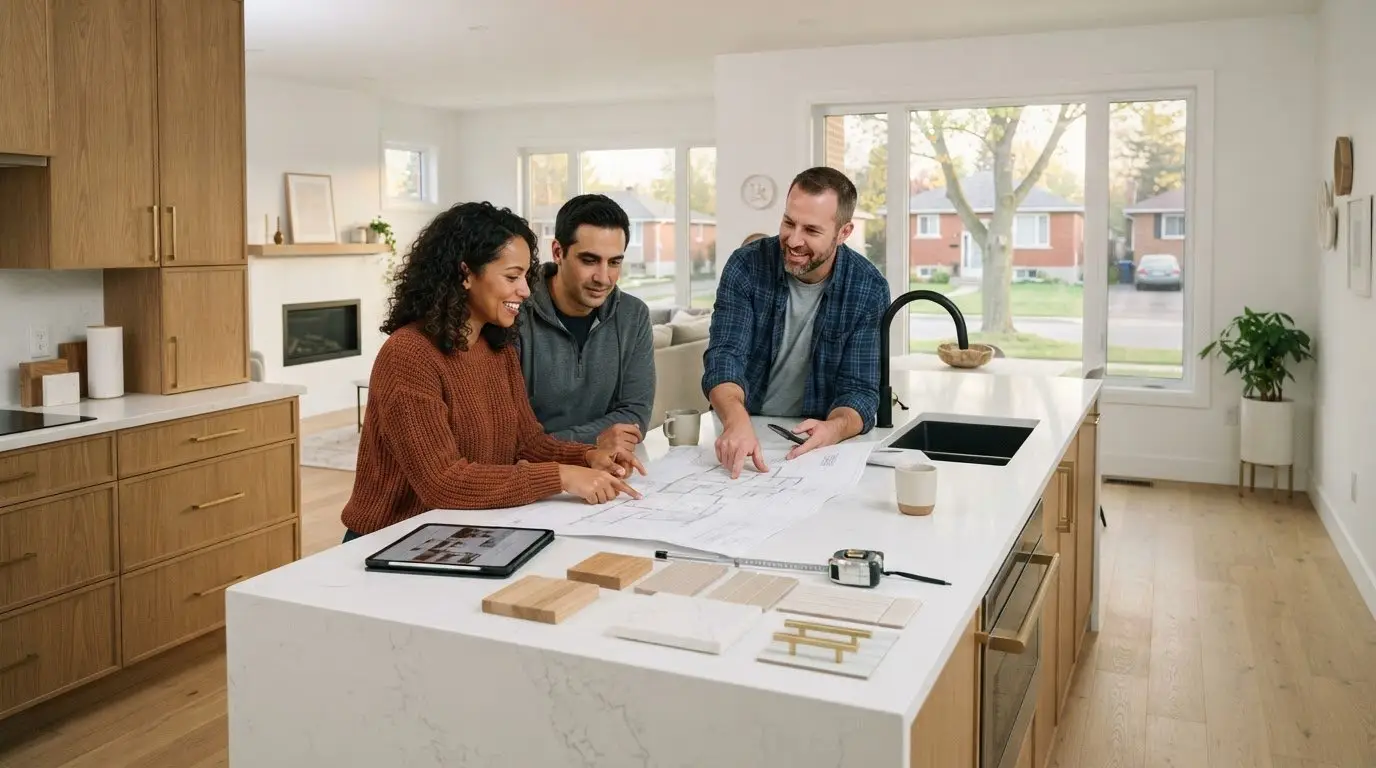
This model establishes single-point accountability. You have one phone number to call, whether your question is about a structural beam, a kitchen layout, or a smart-lighting circuit. By bringing the builder into the design phase from day one, you ensure that every creative choice is backed by a practical understanding of what it takes to build it in the Ottawa market.
The ‘Renovation Gap’: Where Traditional Projects Go Wrong
Most homeowners we speak to are surprised when an independent architect’s $150,000 design receives $250,000 bids from contractors. This is a common scenario because designers often work in a vacuum, focusing on aesthetics without constant feedback on current labor and material costs. Here’s where projects go wrong; the “Renovation Gap” forces you to either spend significantly more than planned or pay the architect again to scale back the drawings. A design-build team uses real-time data to keep the design within your financial guardrails. It also eliminates the risk of finger-pointing, where a contractor blames a designer for a plan error while the designer blames the contractor for poor execution.
What This Means for You: Peace of Mind
You avoid the stress of being the middleman between two professionals who aren’t on the same page. Your project starts with a measured approach, ensuring every square inch of your home is accounted for before a hammer swings. This level of clarity is vital for renovations between $100,000 and $500,000, where the stakes are high and the details are complex. You can learn more about our integrated process to see how we maintain this level of transparency and professional project management from start to finish.
The 4 Critical Phases of a Successful Design-Build Journey
The design-build process for homeowners isn’t a vague sequence of events; it’s a structured methodology designed to protect your capital and your sanity. For an investment between $100,000 and $500,000, you need more than just a sketch. You need a roadmap that accounts for every variable before construction begins. By following a disciplined workflow, you ensure that the high-stakes decisions made early on don’t lead to expensive corrections later.
- Phase 1: Discovery & Conceptualization: We align your aesthetic vision with your functional lifestyle goals to ensure the project is feasible from the start.
- Phase 2: Pre-Construction & Data-Driven Scoping: This is where we remove the “What does it cost?” mystery. According to the Design-Build Institute of America, this integration allows for early cost influence and budget certainty.
- Phase 3: Managed Construction: We use live dashboards to provide proactive communication and timeline transparency, so you’re never left wondering about progress.
- Phase 4: MasterCrafted Handover: A final walkthrough ensures your custom theater or finished basement meets institutional-grade standards and matches the initial 3D rendering.
Why Pre-Construction Planning is Your Best Investment
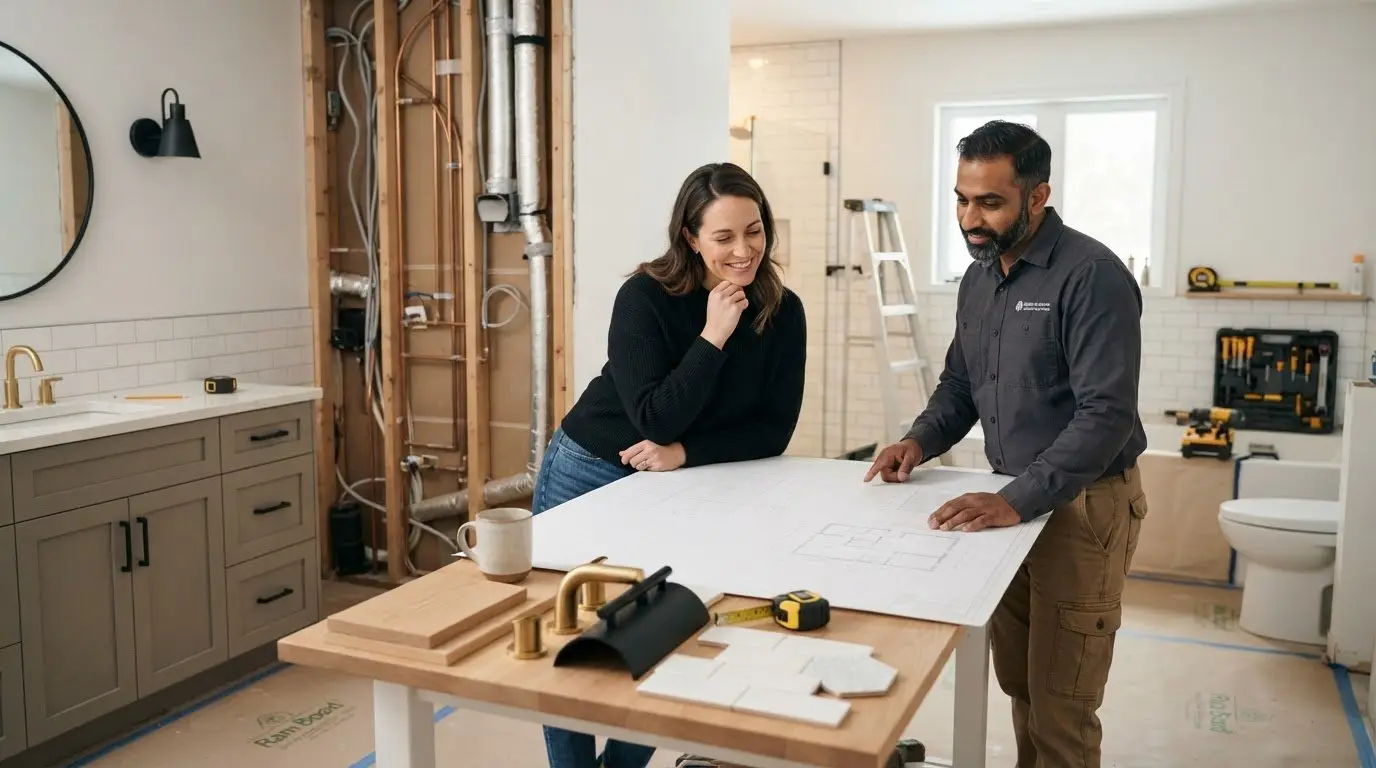
What can go wrong? Most projects fail in the field because they weren’t solved on paper first. In our local Ottawa and Prescott-Russell climate, we frequently identify “unseen” issues like foundation moisture or outdated electrical panels during this phase. Our “Managed” philosophy uses real-world data, not guesses, to provide a fixed-price contract. It’s much cheaper to solve a structural conflict on a computer screen than it is to fix it once the floorboards are up. Choosing the right partner involves looking at their track record for reliability, which you can explore on our why Meraki page.
What to Watch For: The Illusion of the Low Estimate
Watch for contractors who give a “ballpark” price without a design-build scoping phase. This is the top cause of budget overruns. You should ask your contractor: “Does this estimate include a detailed schedule of values or is it just a lump sum?” A lump sum often hides missing details that will eventually surface as expensive change orders. If you want to see how we handle these complexities, you can see our full range of design-build services to understand our commitment to transparency and professional project management.
Is Design-Build Right for Your Ottawa Renovation? Costs and ROI
The design-build process for homeowners is the most efficient way to manage complex renovation projects in the $100,000 to $500,000 range. While professional firms charge for the initial pre-construction and design phase, this upfront investment typically saves between 10% and 15% in change orders during the actual build. By resolving structural or aesthetic conflicts on paper first, you’re planning a successful building project that avoids the “surprise” invoices common in traditional contracting. This model ensures that your financial resources are directed toward high-quality materials and craftsmanship rather than fixing avoidable mistakes.
High-tier value in the current Ottawa market often comes from specialized, future-proofed spaces. Integrating a custom home theater or professional home automation system adds a level of sophistication that generic renovations simply cannot match. However, regional challenges like navigating Ottawa building permits for legal basement suites require a specific level of local immersion. The City has strict requirements for secondary dwellings, and your team must understand the nuances of the Ontario Building Code to ensure your project is both beautiful and compliant.
What Should I Ask My Design-Build Contractor?
- How do you handle budget updates if I change my mind during the design phase? A transparent partner will show you how design changes impact material costs in real-time.
- Do you provide a live dashboard or portal to track my project’s progress? You should have access to timeline updates and documentation without having to chase your contractor for a phone call.
- How do you ensure the final build matches the initial 3D renderings? Ask about their process for translating digital designs into physical construction with pinpoint accuracy.
What This Means for You: Predictability
For a $200,000 basement or theater project, predictability is far more valuable than the lowest bid. You gain a partner who is as invested in the design’s success as they are in the build’s quality. This alignment removes the anxiety of the unknown and replaces it with a structured, professional experience. To dive deeper into how this impacts your specific project, explore our guide to high-value renovations in 2026 or read our advice for homeowners planning $100K+ projects.
Securing the Future of Your Ottawa Home Investment
Investing in a high-value renovation is a significant commitment that requires more than just skilled labor; it requires a sophisticated management structure. We’ve explored how the design-build process for homeowners eliminates the friction between design and construction, ensuring your $100,000 to $500,000 project stays on track. By choosing a model that prioritizes detailed pre-construction planning, you protect your budget from the common pitfalls of separate contracts and vague estimates that often lead to project delays.
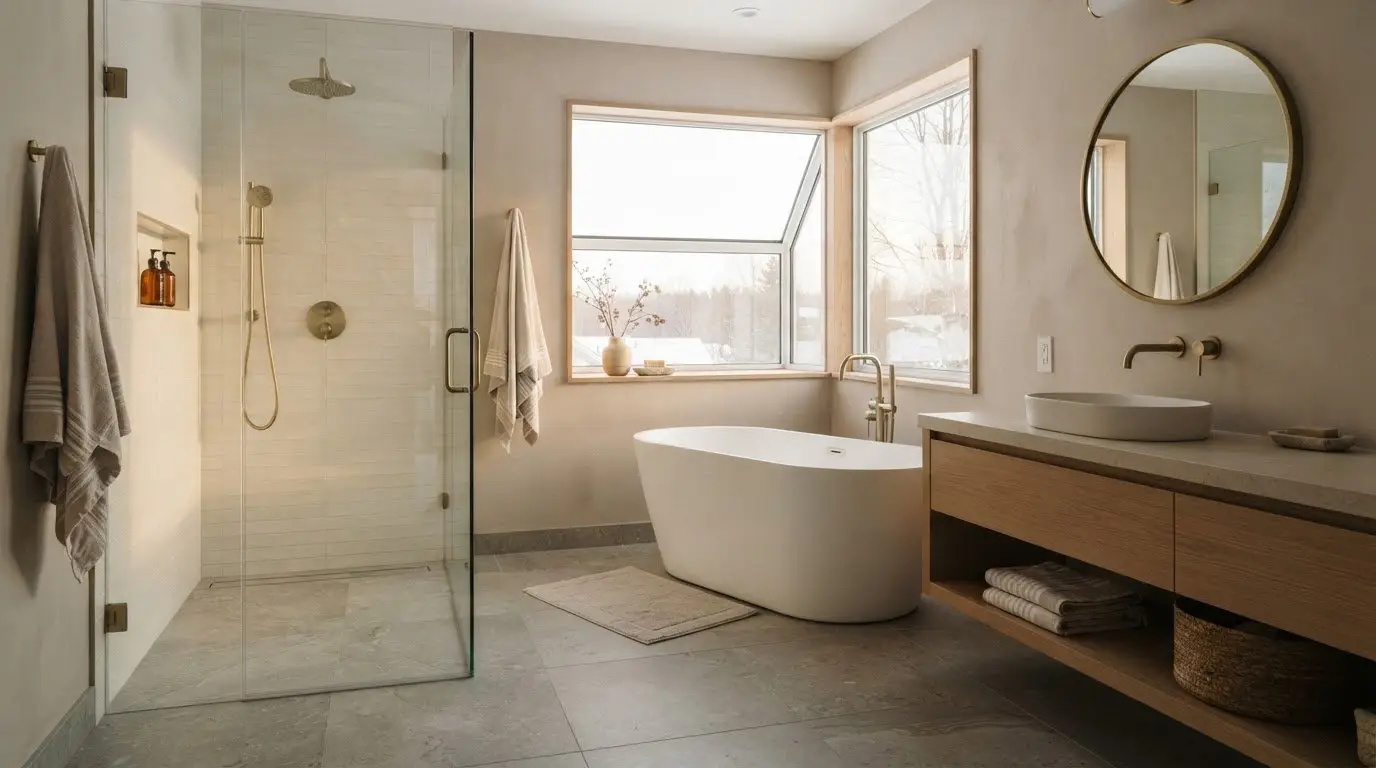
Professional oversight and real-time transparency are essential for your peace of mind. Our proprietary Measured, Managed, and MasterCrafted process uses live project dashboards to keep you informed at every stage of the build. This data-driven approach ensures your custom home theater or basement transformation meets the exact standards of the initial 3D rendering. You deserve a renovation experience that feels like a professional partnership rather than a series of stressful negotiations.
Ready to start your Measured, Managed, and MasterCrafted renovation? Contact Meraki GC today.
With the right structure and a focus on honest communication, your next home transformation can be as predictable as it is beautiful. We look forward to helping you build with confidence.
Frequently Asked Questions
Is the design-build process more expensive than hiring a general contractor?
The total cost of the design-build process for homeowners is often lower when you look at the final project price. While you pay for professional planning and design upfront, this investment typically prevents the 10% to 15% budget overruns common with traditional contractors. You’re paying for financial certainty. Most homeowners we speak to find that avoiding the “low-ball” estimate trap saves them both money and stress during the construction phase.
How long does the design-build process take for a basement or home theater in Ottawa?
A high-value basement or theater project in Ottawa generally spans three to five months from the initial discovery to the final walkthrough. The design and pre-construction phase usually takes four to eight weeks; however, city permitting can add another four to twelve weeks depending on current municipal backlogs. We focus on solving every detail on paper first so the actual construction remains efficient and doesn’t disrupt your family life for longer than necessary.
Can I use my own architect with a design-build firm?
You can certainly bring your own architect, but the most successful projects involve the builder as early as possible in the design phase. When a builder provides real-time feedback on your architect’s drawings, they ensure the structural plans stay within your financial guardrails. This collaborative approach prevents the common “renovation gap” where beautiful plans are designed but cannot be built for the intended budget. It keeps everyone on the same page from day one.
What happens if the design exceeds my initial budget during the planning phase?
If the conceptual design exceeds your budget, we address it immediately during the planning phase before any construction begins. This is a core advantage of the design-build process for homeowners. We use data-driven scoping to show you exactly how different materials or layouts impact the final price. You have the flexibility to adjust the scope or finishes while the project is still on paper, ensuring the final contract matches your investment goals perfectly.

Article by
~ Jason Bourguignon
Jason has been passionate about building homes from a young age, starting his first successful construction company at age 21. With experience across nearly every sector of the industry, he brings a hands-on understanding of the entire building process. For over two decades, he has managed hundreds of custom home builds, additions, and renovations with some single projects exceeding $2.5M. Jason does not just focus on construction, but also helps homeowners create spaces they truly call home.
Disclaimer
The information in this article is provided for general educational purposes only and is based on typical renovation scenarios in Ontario. Every project is unique, and actual costs, timelines, and requirements may vary. This content does not constitute professional, legal, or engineering advice. We recommend consulting with a qualified contractor or specialist for your specific project.