
You have spent months dreaming of a custom kitchen, but the moment a contractor asks for a massive deposit before any work begins, that excitement often turns into a knot in your stomach. Most homeowners we speak to in Ottawa and Prescott-Russell share this same fear. It’s the worry that a project might stall or that a large sum of money could disappear without results. To protect your investment, you need a structured home renovation payment schedule that keeps the contractor motivated and your budget secure.
We believe transparency is the foundation of any successful six figure transformation. In this guide, you’ll learn how to build a fair roadmap where every dollar spent is tied to a verified milestone on your property. We’ll also clarify your legal obligations under the January 2026 updates to the Ontario Construction Act. This includes how the mandatory 10% holdback works and what the new annual release rules mean for your project. By the end, you’ll have the confidence to ask your contractor the right questions and ensure your renovation stays on track from the first day to the final walkthrough.
Key Takeaways
- Learn how to structure a professional home renovation payment schedule that balances contractor cash flow with your need for project security.
- Understand why a 10-15% deposit is the industry standard for securing your spot in the queue and initiating the design phase.
- Discover how to tie every financial release to physical progress on your property, ensuring you only pay for work that has been verified.
- Navigate the updated 2026 Ontario Construction Act requirements, including the mandatory 10% lien holdback and the new annual release rules.
- See how detailed pre-construction scoping creates a transparent, data-driven budget that prevents mid-project financial friction.
Standard Payment Frameworks for Ottawa Home Renovations
A professional home renovation payment schedule is more than a list of due dates. It is a project management tool that ensures financial releases align perfectly with physical progress. Most homeowners we speak to in the Ottawa area are surprised to learn that a well-structured schedule actually reduces friction between the builder and the family. It removes the guesswork by establishing clear expectations before the first sledgehammer swings. When you have a firm grasp on understanding the renovation process, you can see why a progress-based model is the gold standard for high-end projects.
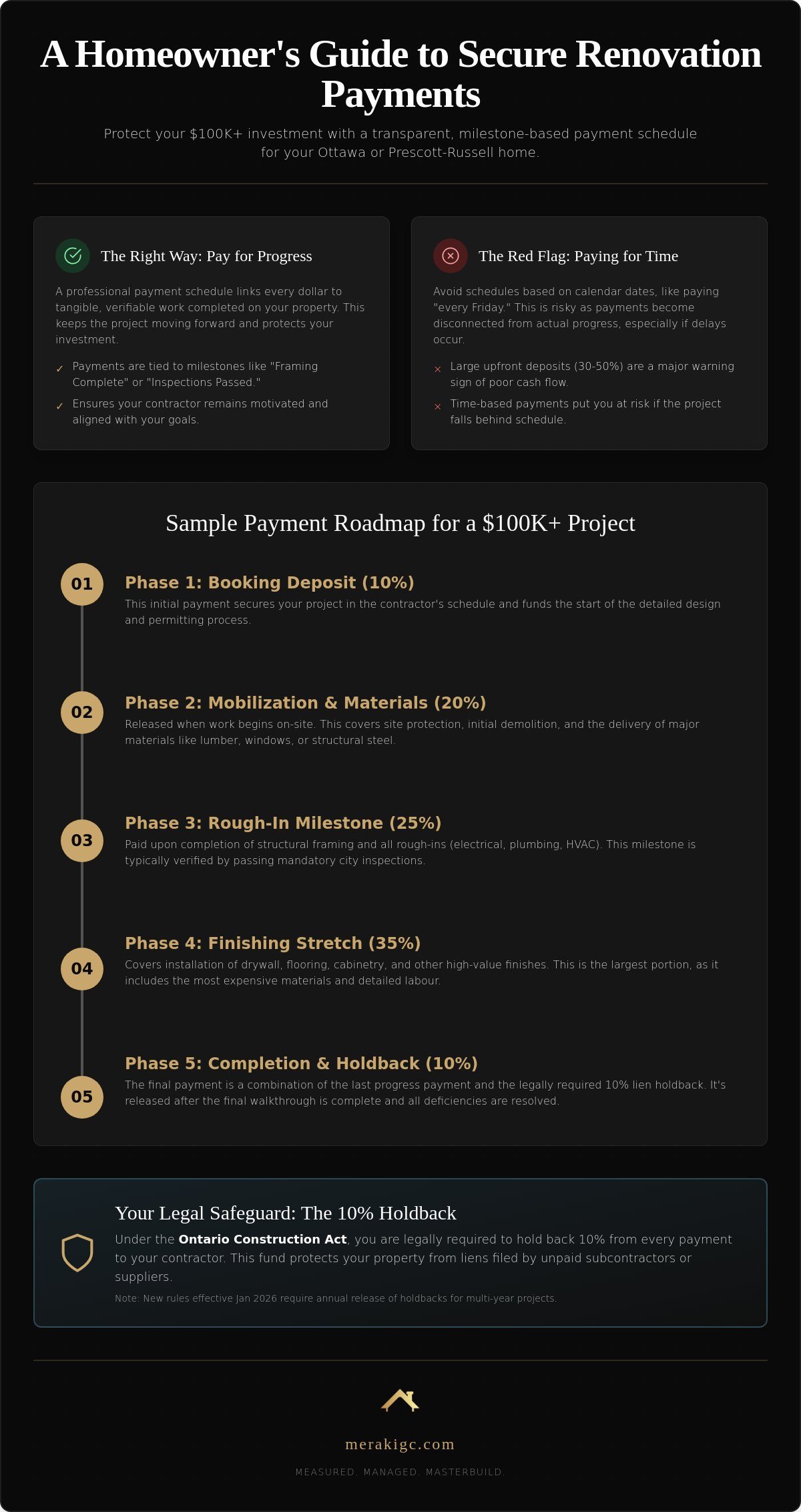
The first step in this framework is the booking deposit. In our region, a deposit of 10% to 15% is standard for securing your project dates and dedicated design resources. Here is where projects go wrong: some contractors ask for 30% or 50% upfront. We advise against this. You should never pay more than 10% to 20% before major materials arrive at your home. A fair schedule protects your capital while giving the contractor the liquidity needed to order custom cabinetry or structural steel.
What this means for you
By insisting on milestone-based payments, you ensure that your money is always working for you. You never get “ahead” of the contractor’s work, which keeps the momentum high and your risk low. If a contractor resists this structure, it is often a red flag regarding their internal cash flow.
The 10% Holdback and the Ontario Construction Act
In Ontario, the law is very specific about how you pay for construction. Under the Ontario Construction Act, you are legally required to retain a 10% holdback from every single payment you make to your contractor. This isn’t just a good idea; it’s a statutory obligation. This money acts as a safety net. It protects you in case the general contractor fails to pay their subcontractors or suppliers. If a lien is placed on your property, that 10% fund is what covers the claim. As of January 2026, new rules also require an annual release of these holdbacks for multi-year projects, so it is vital to track these dates carefully with your builder.
Milestone-Based vs. Time-Based Payments
One of the biggest pitfalls in home improvement is agreeing to time-based payments. Paying a contractor “every Friday” or “every two weeks” is incredibly risky. These schedules don’t account for delays or slow progress. Instead, your payments should be tied to “Milestones.” We define a milestone as a verifiable stage of construction that is easily identified by you or a city inspector. Common milestones include:
- Completion of demolition and site protection.
- Structural framing and window installation.
- Rough-ins for plumbing, electrical, and HVAC.
- Boarding, taping, and priming of drywall.
Linking your pre-construction planning to these specific stages ensures that every dollar released is backed by tangible value added to your home.
Structuring Your Schedule: A Sample $100K+ Renovation Roadmap
A major investment, such as a custom home theater or a full basement transformation, requires a more nuanced approach than a simple “thirds” payment model. High-value projects involve complex logistics and specialized trades that must be managed with precision. Most homeowners we speak to in the Ottawa area find that a four phase roadmap provides the best balance of security and momentum. By aligning your home renovation payment schedule with these specific project stages, you ensure that capital only moves when value has been added to your property.
- Phase 1: The Booking Deposit (10%). This initial commitment secures your spot in the production queue. It allows the team to allocate design resources and finalize the administrative details of your project.
- Phase 2: Mobilization and Materials (20%). This payment is triggered when the dumpster arrives and major materials, such as lumber or HVAC units, are delivered to your site. It covers the heavy upfront costs of starting the physical work.
- Phase 3: The Rough-In Milestone (25%). This occurs once the “bones” of the project are complete. It is specifically tied to passing the necessary City of Ottawa electrical and plumbing inspections.
- Phase 4: The Finishing Stretch (35%). This phase covers the installation of high-value items like custom cabinetry, flooring, and home automation systems.
What this means for you
This structure prevents you from becoming “over-leveraged.” You never want to be in a position where you have paid for 80% of the project while only 40% of the work is visible. This roadmap keeps the builder’s incentives perfectly aligned with your goal: a completed, high-quality home.
The Progressive Payment Breakdown
When reviewing a contract, look for a breakdown that leaves a significant portion for the end. While the 10% statutory holdback is mandatory in Ontario, we recommend keeping an additional 10% as a final completion payment. The final payment is your strongest leverage for quality control. This remaining balance should only be released once every item on the “Punch List” has been addressed and the site is professionally cleaned. When exploring our range of custom build services, you’ll see that we prioritize this level of financial transparency in every agreement.
Common Payment Red Flags to Watch For
Here’s where projects go wrong: a contractor asks for a large “cash-only” discount or demands 50% upfront to “buy materials early.” In the Ottawa and Prescott-Russell region, reputable builders have established accounts with suppliers and don’t need your deposit to keep their lights on. You should also watch for requests for payment before a scheduled inspection has passed. Always ask your contractor: “How will you document that a milestone has been reached before you request the next draw?” A professional will have a clear, data-driven answer.
The Design-Build Advantage: Predictable Payments Through Scoping
Many homeowners we speak to in Ottawa and Prescott-Russell have been burned by “cost-plus” contracts where the final price is a moving target. In those scenarios, a home renovation payment schedule is almost impossible to maintain because the costs are constantly shifting. We take a different approach. By utilizing a “Measured, Managed, MasterCrafted” process, every detail of your project is scoped before a single hammer swings. This intensive pre-construction planning ensures that the budget is data-driven and the milestones are realistic.
For high-end basement and custom home theater projects, a fixed-price contract offers much more stability than cost-plus models. It allows us to build a payment schedule based on firm numbers rather than vague estimates. You’ll know exactly what is due at each stage without worrying about sudden spikes in labor or material costs. This level of predictability is essential when you are managing a significant investment in your home.
Eliminating Financial Surprises with Proactive Communication
Here’s where projects go wrong: a lack of detail in the initial quote leads to a constant stream of “change orders.” These unexpected adjustments can derail your home renovation payment schedule and create unnecessary tension. We eliminate this trap through proactive communication and a dedicated project portal. Our clients use this dashboard to view real-time progress photos, track invoices, and see exactly where the project stands in relation to the next payment milestone. You can learn more about our structured renovation services to see how this technology keeps everyone aligned.
What this means for you
A professional payment schedule is not just a financial document. It’s a reflection of the trust and clarity you share with your builder. When payments are tied to verified progress, the anxiety of “paying too much too soon” disappears. This structure ensures a high-value renovation experience where your only focus is on the design and the final result.
Final advice: if a contractor cannot provide a clear, milestone-based roadmap during the planning phase, they likely haven’t done the work to understand the true scope of your project. Demand transparency early. This ensures your investment remains secure from the first deposit until the final walkthrough.
Secure Your Vision with Financial Clarity
Structuring a fair home renovation payment schedule is the most effective way to maintain project momentum while protecting your hard-earned capital. By insisting on milestone-based draws and adhering to the legal holdback requirements in Ontario, you shift the focus from financial anxiety to the creative details of your transformation. Most homeowners we speak to find that this level of transparency is what separates a stressful renovation from a successful one.
At Meraki, we serve as your trusted advisor throughout the entire $100,000 to $500,000 investment. As active members of the Ottawa construction community, we utilize our proprietary “Measured, Managed, MasterCrafted” process to ensure every dollar is accounted for before work begins. This data-driven approach eliminates surprises and keeps your interests at the center of every decision. You deserve a renovation experience that is as reliable and sophisticated as the finished space itself.
Start your project with a data-driven quote from Meraki GC and take the first step toward a predictable, high-quality transformation. We look forward to helping you build with confidence.
Frequently Asked Questions
Is a 50% deposit normal for a home renovation in Ottawa?
No, a 50% deposit is not standard and is often considered a red flag in the Ottawa market. For a professional home renovation payment schedule, a deposit between 10% and 15% is the industry norm. This amount is sufficient to secure your project dates and begin the design phase. If a contractor asks for half the project cost upfront, it’s possible they have cash flow issues or lack established credit with local suppliers.
What happens to the 10% holdback if the project is delayed?
The 10% holdback remains in your possession until the project reaches substantial completion or its annual anniversary under the 2026 Ontario Construction Act updates. Project delays don’t change your legal obligation to maintain this fund. It exists to protect you against potential liens from subcontractors. You only release these funds once the statutory period for filing a lien has passed, ensuring all trades have been paid by the general contractor.
Can a contractor stop work if I dispute a progress payment?
Most contracts allow a contractor to pause work if a progress payment is withheld, but this depends on why the payment was stopped. If you’re disputing a draw because a specific milestone wasn’t met, the contractor is technically in breach of the home renovation payment schedule. We suggest resolving these issues through a site meeting to verify work against the contract before the dispute leads to a full work stoppage.
Should I pay for materials directly or through my contractor?
It’s generally better to pay for materials through your contractor so they remain responsible for warranties, delivery logistics, and correct measurements. When you buy materials directly to avoid markups, you take on the risk if items arrive damaged or are the wrong size. A professional builder manages the entire supply chain, which includes taking responsibility for any logistical errors that would otherwise become your headache.

Article by
~ Jason Bourguignon
Jason has been passionate about building homes from a young age, starting his first successful construction company at age 21. With experience across nearly every sector of the industry, he brings a hands-on understanding of the entire building process. For over two decades, he has managed hundreds of custom home builds, additions, and renovations with some single projects exceeding $2.5M. Jason does not just focus on construction, but also helps homeowners create spaces they truly call home.
Disclaimer
The information in this article is provided for general educational purposes only and is based on typical renovation scenarios in Ontario. Every project is unique, and actual costs, timelines, and requirements may vary. This content does not constitute professional, legal, or engineering advice. We recommend consulting with a qualified contractor or specialist for your specific project.